Self Checkout Machines for Restaurants and QSR Chains
 Service Automation in Restaurants
A self settlement cashier machine removes the till from the critical path. The guest settles their own bill, the queue splits into parallel lanes, and the person who ran the till moves onto the floor. This guide covers how self checkout differs from an ordering kiosk, the throughput and shrinkage maths that decide whether it pays, the item identification problem that makes or breaks it, and what to check before you buy for an Indian outlet.
Key Takeaways
- Self checkout is a settlement machine, not an ordering machine, and confusing the two produces the wrong purchase.
- Throughput improves because queues run in parallel, not because any single transaction becomes faster.
- Item identification is the whole problem, and it is why the format suits packaged formats and QSR better than plated dining.
- Plan one attendant per bank of machines, because unattended self checkout is where shrinkage and frustration begin.
What self checkout is, and what it is not
Self checkout began in grocery retail and arrived in food service through quick service and grab and go formats. The guest presents items or an order reference, the system totals them, and the guest pays. The staff role shifts from operating the transaction to supervising several of them at once.
It is not the same thing as an ordering kiosk, although suppliers frequently blur the two. An ordering kiosk takes a food order and sends it to the kitchen. A self checkout settles a bill for items already selected or already prepared. They solve different problems and belong at different points in the guest journey.
In an Indian outlet the distinction matters commercially. Many venues have no ordering delay at all because guests are happy to order from a person, but they have a settlement delay because one till serves everybody at the end of the meal. A checkout machine addresses that directly and a kiosk does not.
The format also suits venues where the order is assembled by the guest. A bakery counter, a buffet with weighed plates, a convenience style outlet inside a hotel and a cafeteria are all situations where the guest arrives at the payment point already holding what they want.
Where it fits poorly is plated table service. A guest who has been served at a table expects the bill to come to them, and asking them to carry a number to a machine feels like a downgrade rather than a convenience. Tabletop settlement is the right format there instead.
Understanding this boundary before you shop saves both money and credibility. The most common failure in this category is a machine installed in a venue whose actual friction sits somewhere else entirely, which then gets blamed on the technology rather than on the diagnosis.
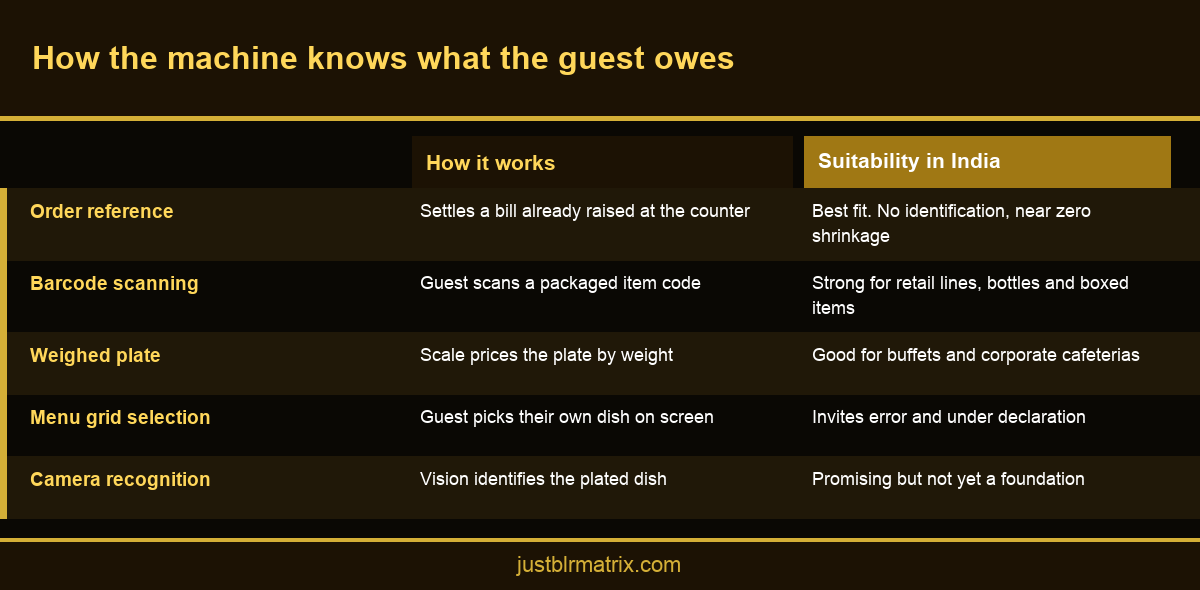 Comparison infographic of item identification methods for self checkout machines in restaurants
The item identification problem
Everything about self checkout performance comes down to how quickly and accurately the machine knows what the guest is buying. Get that right and the transaction takes seconds. Get it wrong and every guest needs help, which converts a labour saving into a labour increase.
Packaged items are straightforward because they carry a code. Bottled drinks, packaged snacks, boxed desserts and retail lines all scan reliably, which is why convenience formats inside hotels and fuel stations adopted self checkout long before restaurants did.
Prepared food is the hard case. A plate of biryani has no barcode, and asking a guest to identify their own dish from a menu grid invites both honest error and deliberate under declaration. This is the single largest reason plated formats resist self checkout.
Order reference settlement sidesteps the problem entirely. The guest orders at a counter, receives a token or a code, and the machine simply settles the bill already raised against that reference. No identification is required, and this is the configuration that works best in most Indian restaurant settings.
Weighed formats sit in between. A buffet priced by weight works well because the scale does the identification, and this is a genuinely good fit for corporate cafeterias and hotel breakfast operations where per weight pricing is already accepted by guests.
Camera based recognition of plated food exists and is improving, but it is not yet dependable enough across a varied Indian menu to be the primary mechanism. Treat it as a supporting feature rather than a foundation, and anchor the design on order reference settlement through your POS platform.
Throughput, shrinkage and the numbers that matter
The throughput gain does not come from speed. An individual self checkout transaction is often slightly slower than a trained cashier because the guest is less practised. The gain comes from parallelism, because three machines process three guests simultaneously where one till processes one.
That distinction changes how you size the installation. Count your peak fifteen minute transaction volume, divide by a realistic per machine rate of around thirty to forty transactions an hour, and you have your machine count. Adding machines is the lever, not choosing a faster one.
Shrinkage is the risk everyone raises and it is real but manageable. Where guests identify their own items, some under declaration occurs. Where the machine settles a pre raised order reference, the exposure is close to zero because the guest cannot change what they owe.
That is another argument for the order reference configuration in Indian outlets. It removes the shrinkage question from the business case entirely, which also removes the conversation about surveillance and trust that self checkout otherwise triggers with staff and guests alike.
Attendance is the other control. A staffed position supervising a bank of machines resolves failures, helps first time users and deters under declaration simply by being present. Budget one attendant per bank rather than assuming the machines run themselves.
Finally, measure adoption rather than assuming it. Track the share of transactions going through self checkout weekly. If it plateaus below a third, the problem is usually placement, signage or the first screen rather than guest reluctance in general.
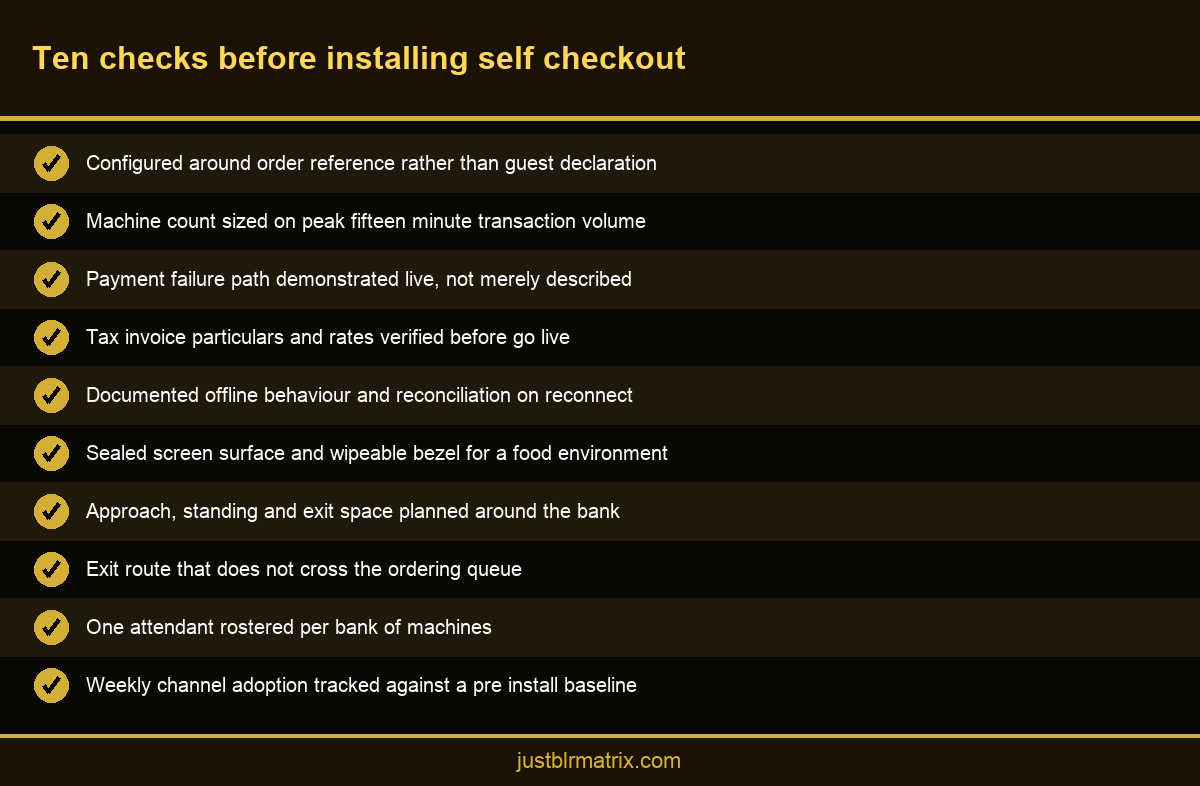 Checklist infographic of ten buying checks for restaurant self checkout machines
Buying checks for an Indian outlet
Confirm the payment methods supported and how each fails. Card, UPI and wallet all behave differently when a transaction does not complete, and a guest stranded mid payment with food in hand is the worst possible failure mode. Ask to see the failure path demonstrated, not described.
Check invoicing. Every transaction must produce a compliant tax invoice with the correct rate for the item category, issued at the point of supply. Verify the configuration against current GST requirements before go live rather than correcting invoices retrospectively.
Establish offline behaviour explicitly. Indian outlets lose connectivity, and a machine that stops working during an outage sends the entire queue back to a single till that is no longer staffed for it. Ask what the device does offline and how it reconciles afterwards.
Look at the physical build for the environment. Screens get touched with oily hands, spills happen, and cleaning is frequent. A sealed screen surface, a wipeable bezel and a sensible ingress rating matter more in a food environment than in a retail one.
Plan the floor space and the flow. A bank of machines needs approach space, standing space and an exit route that does not cross the ordering queue. Machines installed against a wall in a corridor create congestion that cancels out the queue reduction they were bought to deliver.
Finally, decide how it fits the wider service plan. Self checkout works alongside tabletop settlement, waiter pads and service robotics, and choosing the combination once is far cheaper than adding a second format after the first one only partly solved the problem.
Conclusion
A self checkout machine pays for itself when the outlet has a settlement queue, when items can be identified reliably, and when the installation is supervised. Configure it around an order reference rather than guest declaration, size it by parallel lanes against your peak fifteen minutes, and test the payment failure path before launch. Enquire now to scope self checkout for your outlet.
Frequently Asked Questions
What is the difference between self checkout and an ordering kiosk?

Does self checkout make transactions faster?
How many machines do I need?
Is shrinkage a serious risk?
Can self checkout handle plated Indian food?
Do I still need staff at the machines?
What happens if the internet drops?
How do I know if guests are actually using it?
What should I install alongside self checkout?