Restaurant Kitchen Automation: The Complete 2026 Guide
 General
Restaurant kitchen automation is usually sold as a single decision and bought as one. It is neither. A commercial kitchen is a sequence of stations, each with its own bottleneck, its own labour profile and its own return on automation. This guide works through the kitchen station by station, explains what equipment solves which constraint, and sets out how to sequence a retrofit without shutting the kitchen down. It is written for operators planning a real budget.
Key Takeaways
- Automation returns vary enormously by station. Prep and forming usually deliver the fastest payback, while cook line automation delivers the most visible change.
- The correct order is diagnose, automate the tightest constraint, measure, then reinvest the saving. Buying a full stack at once is how budgets get stranded.
- Automated kitchen equipment replaces repetition and measurement. It does not replace judgement, menu development, or the ability to recover when service goes wrong.
What Restaurant Kitchen Automation Covers
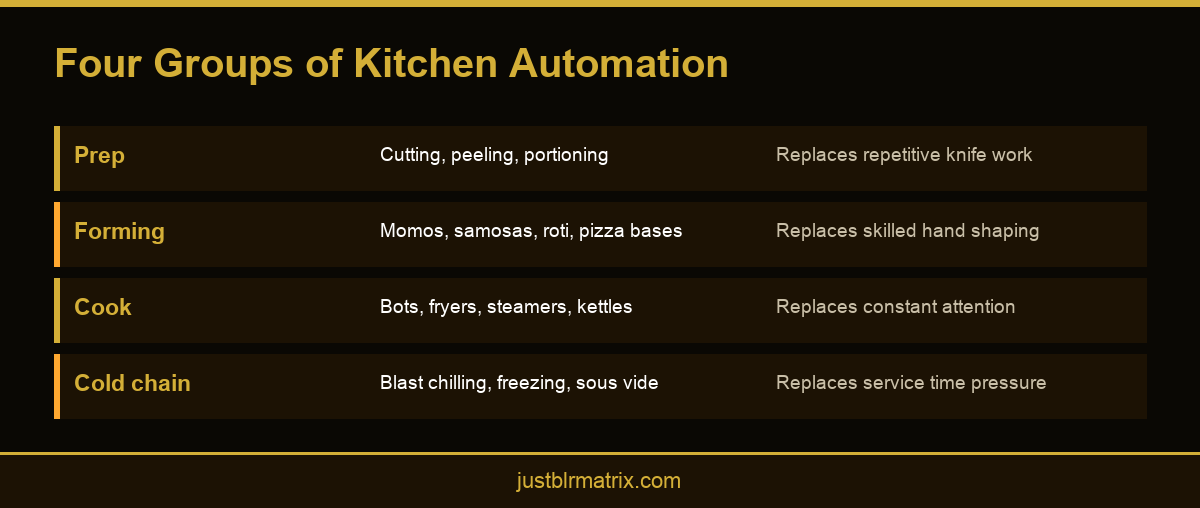
Commercial kitchen automation is not one product category. It spans four distinct groups of equipment, and a kitchen can adopt any of them independently. Confusing them is why quotes are so hard to compare and why so many projects deliver less than expected.
The four groups are prep, cook, forming and cold chain. Each addresses a different kind of labour. Prep automation replaces repetitive knife work. Cook automation replaces attention, meaning the requirement that someone stands over a process. Forming automation replaces skilled hand shaping. Cold chain automation replaces time, by allowing food to be produced ahead of service rather than during it.
Understanding the split also prevents a common budgeting error. Operators frequently compare a cooking bot against a vegetable cutter on price, conclude the cutter is better value, and buy it without checking which station is actually constraining service. The two solve unrelated problems, and the right question is which constraint is costing covers rather than which machine costs less.
Each group also carries a different risk profile. Prep and forming automation change what happens before service, so a failure is inconvenient but recoverable. Cook line automation changes what happens during service, so a failure is immediate and visible. That difference should influence both the order of purchase and how much you spend on service cover.
Prep and Forming
These are the highest labour intensity stations in most Indian kitchens and the least skilled. Cutting, peeling, portioning, and shaping items such as momos or rotis consume enormous staff hours that produce no differentiation. Automating here rarely affects the character of the food, which makes it the safest place to start.
Cook and Hold
Cook automation changes how the line operates and therefore carries more risk. It also delivers the most visible consistency gain, because it removes variance between shifts. Cold chain and holding equipment sit alongside it, decoupling production time from service time.
 Infographic showing the four equipment groups in restaurant kitchen automation and the labour each replaces
Station by Station: Where the Time Actually Goes
Before comparing equipment, measure where your kitchen hours are consumed. Most operators are confident they already know, and most are wrong, because the largest costs are the ones spread thinly across the whole day rather than concentrated in a visible peak.
Run a simple exercise. Over one normal week, log staff hours by station rather than by shift. Separate prep from cook, and separate forming from both. The result usually shows that prep and forming together consume more hours than the cook line, despite the cook line receiving nearly all the management attention and nearly all the equipment budget.
This is the single most useful diagnostic in the whole process, and it frequently changes the purchase order entirely. A kitchen convinced it needs an automated kitchen robot on the cook line often discovers that four hours a day disappear into vegetable preparation before service even begins. Fixing that is cheaper, faster and less disruptive. The Indian food services industry overview from IBEF provides sector level context for benchmarking your own cost structure.
The exercise also reveals hidden overtime. Prep work that overruns pushes into service hours, which is expensive twice over: once in wages and once in the disruption of starting service with a station still catching up. Kitchens frequently discover that what they had classified as a staffing shortage is really a prep throughput problem with an equipment solution.
Repeat the measurement after any change. A kitchen that automates cutting will find its bottleneck moves rather than disappears, usually to the next most labour intensive station. Measuring again after each stage keeps the programme pointed at the current constraint instead of the one that justified the original business case.
Include the head chef in the measurement rather than presenting conclusions afterwards. Kitchen teams know where the day genuinely goes, and they will identify the tasks that quietly consume hours long before a spreadsheet does. They are also the people who have to work with whatever is installed, so involving them early converts a management decision into a shared one and removes most of the resistance that surfaces later.
Prep Automation: Cutting, Peeling and Portioning
Prep is where most kitchens should begin, for three reasons. The labour is repetitive rather than skilled, the equipment retrofits without structural work, and the saving appears within days rather than months.
Cutting is the largest single component. A multifunction vegetable cutter handles volumes that would otherwise occupy several staff through the morning, with consistent cut sizes that also improve cooking uniformity downstream. That second benefit is routinely overlooked: inconsistent cuts cook unevenly, which creates waste and complaints that get blamed on the cook line.
Peeling is the second component and is particularly heavy in Indian kitchens because of onion volumes. An automatic onion peeler removes a task that is slow, unpleasant, and a common cause of staff turnover in prep roles. The labour argument here is reinforced by a retention argument that rarely appears in equipment proposals but matters considerably in practice.
For a detailed comparison across cutting and peeling formats, see our guide to commercial vegetable cutting and peeling machines. Meat preparation follows the same logic, with washing, slicing and vacuum marination equipment addressing an equally repetitive load that is usually absorbed invisibly into general kitchen hours.
Waste reduction is the second financial line and it is routinely underestimated. Hand cutting produces variable yields, and variability shows up as both excess trim and inconsistent portions. Machine cutting narrows that spread, which lowers food cost per cover without any change to the menu, supplier or portion specification.
Hygiene improves as a side effect. Less hand contact with prepared ingredients means fewer contamination points, and consistent equipment cleaning schedules are easier to document than individual handling practice. In kitchens working toward a formal food safety standard, this is often as valuable as the labour saving that justified the purchase.
Cook Automation: Bots, Fryers, Steamers and Kettles
Cook line automation is what most operators picture when they hear kitchen automation, and it is genuinely transformative. It is also the group that changes how the kitchen works, so it should follow prep rather than precede it.
Recipe recalibration is the step most projects underestimate. Timings developed for manual cooking rarely transfer unchanged to controlled equipment, and the first weeks after installation should be treated as a tuning period with the head chef involved. Kitchens that skip this and judge the equipment on week one results usually conclude it cannot cook their food, when it simply has not been set up to.
Multi Cuisine Cooking Bots
A cooking bot handles stirring, timing and temperature without a person standing over the pan. A robotic four way cooking machine runs several preparations in parallel, which is what makes it viable for Indian menus where a single order can involve multiple gravies. Throughput gains are largest where the same few preparations repeat constantly, which describes most high volume Indian menus.
Fryers, Steamers and Kettles
Frying, steaming and sauce production are the three processes most improved by automation, because all three reward precise timing. An automatic fryer manages basket lifting and oil life, a bulk food steamer handles rice and steamed items at volume, and a jacketed sauce kettle produces base gravies consistently. Batch sizing matters most here, since a kettle rated well above your daily gravy requirement wastes both energy and floor space.
 Infographic comparing a manual and an automated commercial kitchen line across four operational measures
Forming Automation for Indian Menu Formats
Forming is where automation intersects most directly with Indian menus, and where imported equipment lists are least useful. Momos, samosas, rotis and naan are all hand shaped at volumes that consume entire roles.
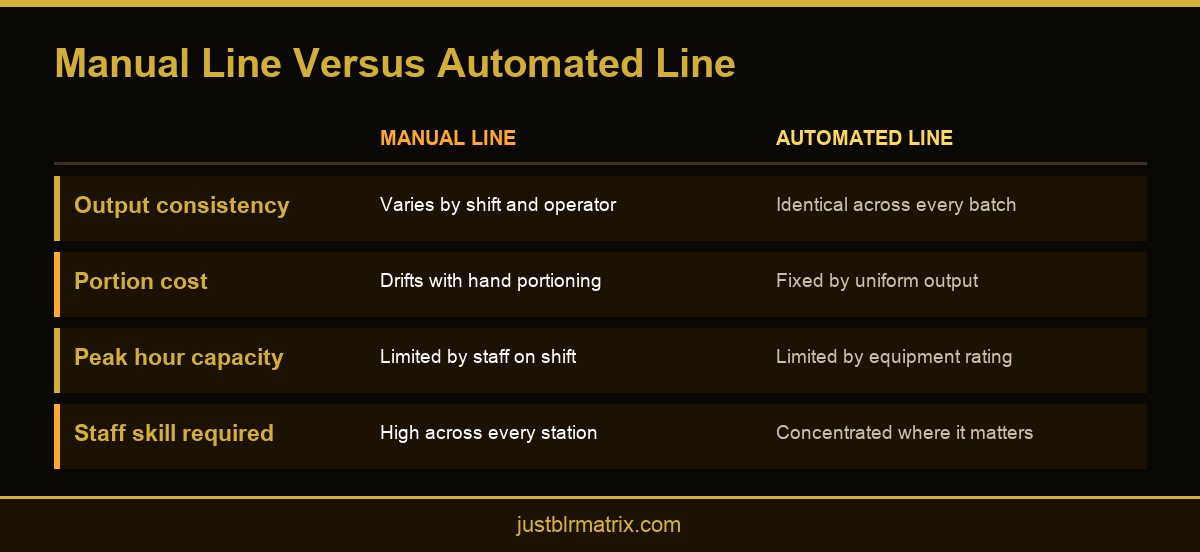
The labour case is unusually clear here. Hand forming is slow, requires trained staff, and produces output that varies in weight and therefore in cost. A robotic dumpling and momo former produces uniform items at rates a manual team cannot match, and uniformity matters commercially because it fixes portion cost. Our guide to machines for momos, samosas and dumplings at commercial scale compares the formats available.
Breads follow the same pattern. An electric rotary naan and pita maker addresses a station that traditionally requires a dedicated skilled operator working continuously through service. For pizza formats, a dough base press removes both the skill requirement and the variance in base thickness that drives inconsistent bake times.
Cloud kitchens benefit disproportionately from this group. Their economics depend on output per square foot, and forming automation raises that number without expanding the footprint, which is exactly the constraint a delivery only operation faces.
Consistency also changes what the kitchen can promise. Uniform items cook in predictable times, which makes service timing reliable and allows accurate quoting on delivery platforms where late orders carry a direct commercial penalty. For delivery led operations this predictability is frequently worth more than the labour saved in the forming itself.
Staffing flexibility improves alongside it. Hand forming ties output to the availability of a specific skilled person, so a single absence can remove an entire menu section for a shift. Machine forming decouples that dependency, which is a meaningful operational protection in a sector with high turnover in skilled prep roles.
Cold Chain: Blast Chilling, Freezing and Sous Vide
Cold chain equipment is the least understood group and often the most valuable, because it does something the others cannot. It decouples production from service.
Blast chilling takes cooked food through the temperature range where bacteria multiply fastest, quickly enough to be safe, which allows a kitchen to cook in the morning and serve in the evening. A blast freezer for food makes batch production viable, converting service time pressure into planned production time. Our post on choosing a blast chiller for restaurant kitchens covers specification.
Sous vide extends the same principle further, holding food at precise temperature for long periods to achieve texture that conventional cooking cannot, while allowing production well ahead of service. A commercial sous vide unit suits banqueting and premium formats particularly well. Wikipedia's overview of sous vide explains the underlying method.
Both depend on rigorous handling discipline. Cooking ahead is safe only when chilling, storage and reheating are controlled and documented, which falls under standard food safety controls and, more broadly, the principles set out by the World Health Organization. Handled properly this is a major operational gain. Handled casually it is a serious risk, and it should not be adopted without the process discipline to support it.
Space planning deserves early attention. Cooking ahead only helps if there is somewhere to store what you have produced, and kitchens frequently install chilling capacity without expanding the cold storage it feeds. Assess storage volume alongside chilling capacity, otherwise the equipment will be constrained from the day it is commissioned.
Labelling and rotation discipline become critical once production and service are separated. A kitchen cooking two days ahead needs to know precisely what was made when, and an informal system that worked when everything was cooked to order will fail quickly under batch production. Agree the labelling standard before the equipment arrives, because retrofitting the discipline afterwards is considerably harder than establishing it from the first batch.
Sequencing a Retrofit Without Closing the Kitchen
A kitchen cannot stop trading while it is rebuilt, so sequencing matters more than specification.
Begin with countertop prep equipment, which needs power and nothing else. Cutting and peeling machines install between services and start saving hours immediately, which builds internal confidence and, importantly, produces the evidence needed to justify the next stage of spending.
Move next to forming equipment, which is similarly undemanding to install but changes how a station is staffed, so it needs a short training period. Leave cook line equipment until last, because it requires electrical capacity, sometimes ventilation changes, and always a period of recipe recalibration as timings shift from manual to controlled.
Energy infrastructure deserves a specific note. Kitchens moving from gas to electric equipment need their electrical supply assessed before ordering, not after delivery. This catches out more projects than any other single issue. Our posts on switching to a plasma electric cooking stove and the plasma electric stove itself cover the practical implications of that transition.
Plan for a temporary dip in output around each installation. Even well managed changes disrupt a kitchen briefly, and scheduling two installations in the same week compounds the disruption rather than getting it over with. Spacing them, and choosing the quietest trading period for the most invasive work, keeps service intact while the programme progresses.
Document the old process before replacing it. Kitchens that lose the manual method entirely have no fallback when equipment fails, which turns a maintenance issue into a service failure. Keeping a written manual procedure and occasionally practising it costs almost nothing and protects the operation on the night something breaks.
Costing, Payback and the Business Case
The same equipment produces very different returns depending on the format it sits in, which is why generic payback claims should be treated sceptically.
Present the case on four lines, kept separate so you can see which investment is actually working.
The first line is labour hours removed, valued honestly at what those hours cost including overheads rather than at base wage. The second is waste reduction, which comes mainly from consistent portioning and uniform cutting, and is usually larger than operators expect. The third is capacity gained, meaning covers you can now serve that you previously turned away at peak. The fourth is quality consistency, which is real but hard to quantify and should therefore support the case rather than carry it.
Set against these, count the full cost: equipment, installation, electrical or ventilation work, training, and a realistic service contract. Across a multi outlet group, pilot in one kitchen and measure for a full quarter before rolling out, since seasonal variation in Indian venues is large enough that one month of data will mislead you.
For a view spanning kitchen, bar and service together, our hospitality automation company guide sets out how the three interact, and our post on robotic kitchen machines for high volume cooking covers the equipment shortlist in more depth. Sector background is available from Invest India's food processing overview.
Multi outlet groups should also weigh standardisation. Running identical equipment across sites simplifies training, spare parts, service contracts and recipe transfer, and it allows performance to be compared meaningfully between kitchens. That consistency is often worth accepting a slightly imperfect fit at an individual site, particularly where staff move between locations.
Present the risks alongside the returns. Equipment that fails without a service arrangement, electrical capacity discovered late, or a team that was never trained properly will each undermine the numbers, and a business case that acknowledges them is considerably more credible than one that does not. Naming the risks also makes them someone's responsibility, which is usually enough to ensure they get managed.
Training deserves its own line in the budget rather than being folded into installation day. Kitchen teams need to rehearse a new sequence before a busy service, ideally while the old method is still available as a fallback, and they need to know what the equipment does when something goes wrong. A team that has only ever seen a machine working correctly will freeze the first time it stops.
Be honest with the team about intent as well. Staff who suspect automation is a prelude to redundancy will not engage with it, and quiet resistance is remarkably effective at making good equipment look useless. Where the plan is redeployment rather than reduction, saying so plainly at the outset removes the single largest obstacle to adoption.
Capex Bands by Format
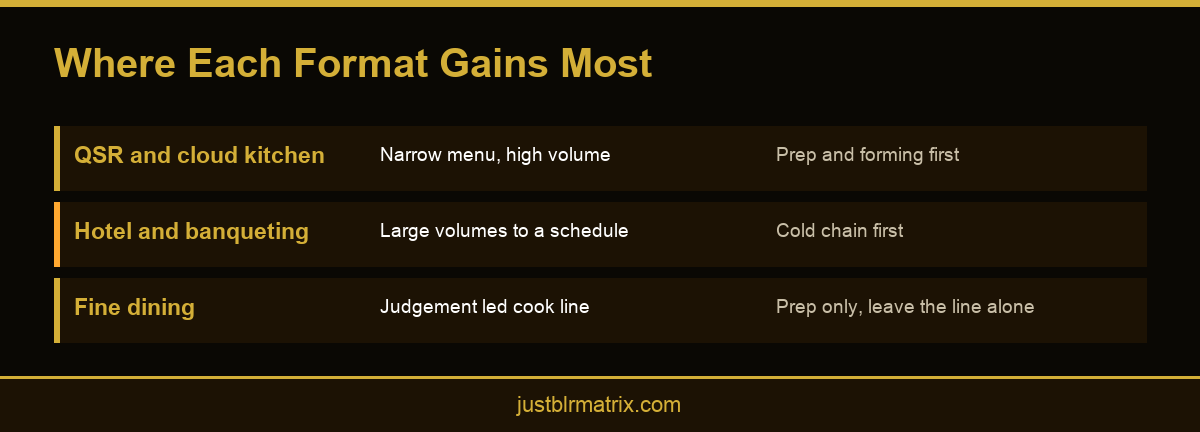
QSR and cloud kitchens gain most from prep and forming automation, because their menus are narrow and their volumes are high, which is the ideal condition for repetitive automation. Hotels and banqueting gain most from cold chain, because their challenge is producing large volumes to a schedule. Fine dining gains least overall and should automate prep only, leaving the cook line to the kitchen team.
What Automation Does Not Replace
Automated kitchen equipment replaces repetition and measurement. It does not replace menu development, judgement about ingredient quality, or the ability to recover when something goes wrong mid service. Kitchens that reduce headcount on the assumption that machines cover these functions generally reverse the decision within a year. Plan for redeployment, not replacement.
 Infographic showing which kitchen automation group delivers the strongest return for each outlet format
Conclusion
Restaurant kitchen automation works when it is treated as a sequence rather than a purchase. Measure where your hours actually go, automate the tightest constraint first, and let the saving fund the next stage. In most Indian kitchens that means prep and forming before the cook line, and cold chain wherever production and service need to be separated. Just BLR Matrix has deployed these systems across 34 outlets, 200 plus tested systems and 80 plus installations. Request a demo to start with a station by station assessment.
Frequently Asked Questions
Where should a kitchen start with automation?

How much does restaurant kitchen automation cost?
Will kitchen automation let me reduce headcount?
Which outlet formats benefit most from automation?
Is commercial kitchen automation suitable for Indian menus?
What is the most common planning mistake?
How does cold chain equipment change kitchen operations?
How long should I pilot before rolling out across outlets?
Should I automate the kitchen or the bar first?