Kavach.ai SOP Recording Badge: The Complete Guide for F&B
 Service Automation in Restaurants
The Kavach.ai SOP recording badge is an ID badge with a built in audio recorder that checks whether front of house staff follow your service standards. It records greetings, upselling, order taking and complaint handling, then turns those recordings into compliance reports a manager can review from anywhere. This guide explains how the Kavach.ai SOP recording badge works, what it can and cannot measure, where it fits in hotels and restaurants, what it costs, and how to introduce it so staff see it as fair coaching rather than surveillance. The badge product page has the full specification.
Key Takeaways
- The Kavach.ai SOP recording badge records staff interactions with time and date stamps and syncs them to a cloud dashboard for review.
- It measures verbal SOPs: greetings, upselling, order accuracy, complaint handling and spoken hygiene checks.
- Listed at Rs 11,188 per badge, it is priced for deployment across a whole floor team rather than one supervisor.
- Disclosed, consent based use is both the legal route and the one that actually improves behaviour.
What is the Kavach.ai SOP recording badge?
The Kavach.ai SOP recording badge looks like the ID badge your staff already wear. Inside it is an audio recorder and the connection that sends recordings to a cloud dashboard. Just BLR Matrix describes it as a smart employee monitoring badge that uses AI based performance recording and machine learning SOP analytics to track staff actions, record SOP compliance and generate insights for training and discipline.
A standard operating procedure in hospitality is usually spoken. Greet the guest within a set time. Offer the specials. Repeat the order back. Ask about allergies. Apologise and escalate a complaint in a set way. These standards are written in a manual, taught in induction, and then mostly left to chance, because no manager can stand beside every server on every shift. The result is a gap between the standard on paper and the service a guest actually receives, and that gap is widest on the busiest nights and the quietest late shifts, when supervision is thinnest.
The badge closes that gap. Because it records continuously during a shift, it captures how standards are actually delivered rather than how staff behave when a manager happens to be watching. Managers review what happened instead of relying on memory, guest comments or the occasional spot check.
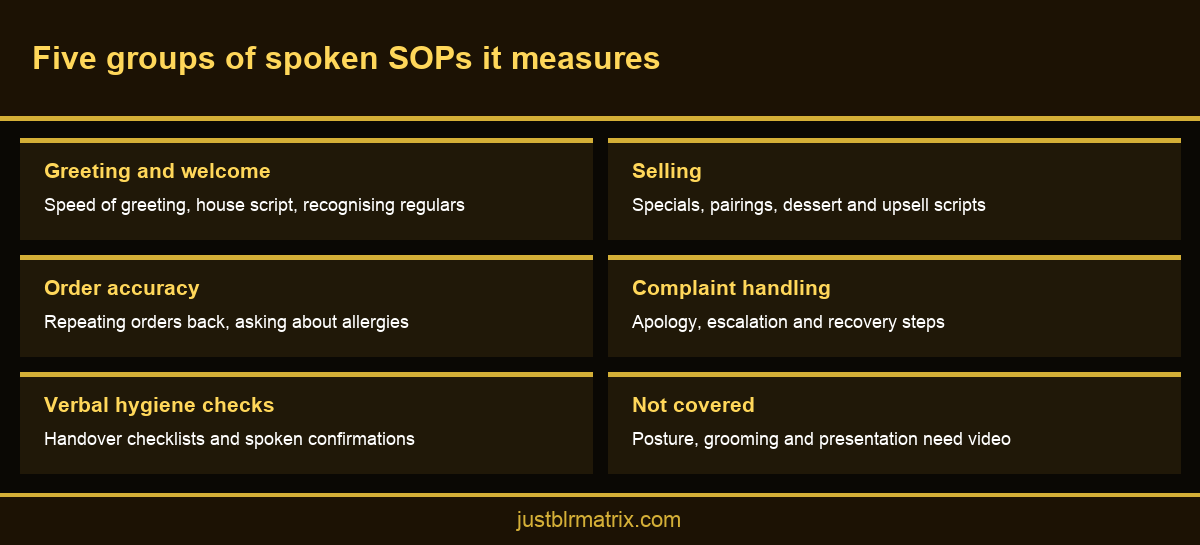
It is important to be precise about scope. The badge records audio, not video. It measures what is said, which covers most front of house standards, but it does not show posture, grooming or plate presentation. Those need other tools, such as an intelligent CCTV black box for the floor.
How the badge differs from CCTV
CCTV shows where people are and what they do, usually without sound. The badge captures what staff say to guests and colleagues, attached to one person's shift. For a hotel or restaurant, the spoken part of service is often the part that decides whether a guest returns. The two are complementary rather than alternatives.
How it differs from mystery shopping
Many groups already use mystery shopping to audit service. A mystery shopper sees a handful of interactions a month and reports one visit. The badge captures every interaction on a shift. Mystery shopping still has a role, because it measures the whole guest experience, but the badge supplies the volume of evidence a shopper never can.
Why audio is the right medium for SOPs
Most service standards are verbal by nature. A greeting, an allergy question and a complaint apology are all words. Audio captures them directly and with far less data than video, which keeps storage and review manageable. It also feels less intrusive to many staff than a camera trained on them throughout a shift.
How it records, stores and reports
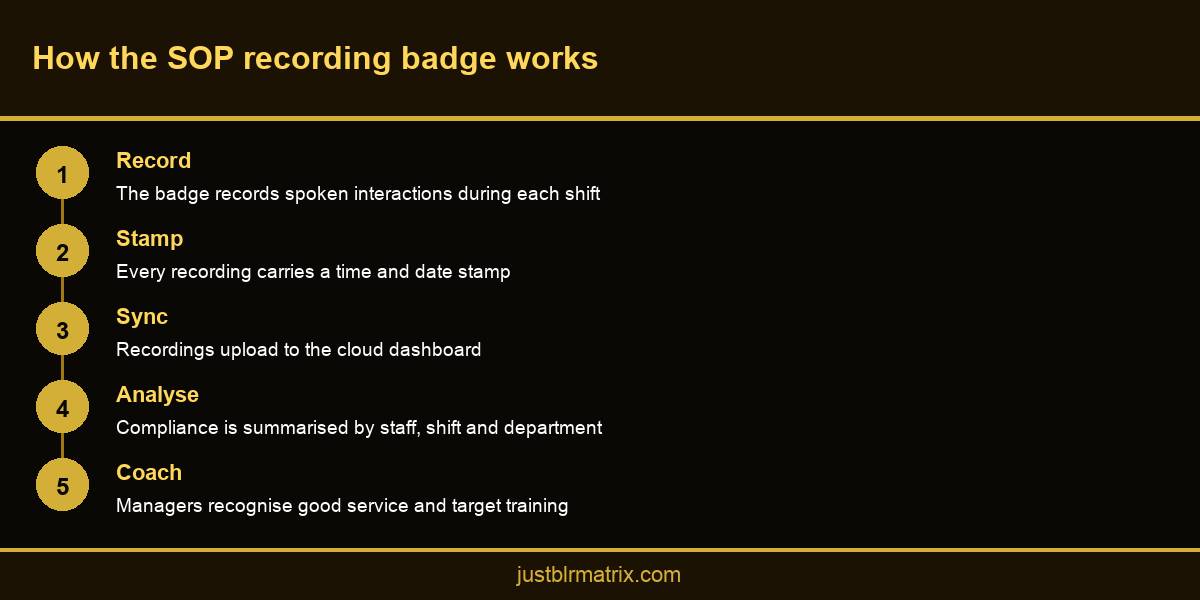
The working cycle has four stages. The badge records during the shift. Each recording carries a time and date stamp. Recordings sync to the cloud dashboard. Managers review them, and the analytics layer summarises compliance across staff, shifts and departments.
Time and date stamping is what turns audio into evidence. When a guest complains about a rude response at 8.40 pm on Saturday, a manager can find the exact interaction rather than taking one side. Just BLR Matrix highlights this as instant audio proof for disputes, which removes guesswork and hearsay from difficult conversations.
Remote review is the second practical gain. According to the product information, recordings sync to a cloud dashboard that managers can access from anywhere, at any time. An operations head responsible for several outlets can review compliance without travelling to each one.
The analytics layer is the third. Rather than listening to hours of audio, managers see summaries: which SOPs were followed, which were missed, and where the gaps cluster. That is the part Just BLR Matrix describes as machine learning SOP analytics, and it is what makes the badge usable at scale.
Access control on the dashboard matters as much as the recording itself. Decide which roles can listen to which teams, log every access, and keep the list short. A floor manager may need their own outlet's recordings, while an operations head needs summaries across outlets. Few people need raw audio from every site, and limiting access is one of the simplest ways to keep staff trust.
Department wise violation analytics
The dashboard groups results by department, so a manager can see that the bar team misses the allergy question more often than the restaurant floor, or that the night shift skips the upsell script. That turns training from a general refresher into a targeted fix for the specific team and standard that needs it.
Incentive and disincentive reports
Just BLR Matrix lists clear incentive and disincentive reports based on actual evidence rather than assumptions. Used well, these reward the staff who consistently deliver standards. Used carelessly, they become a punishment tool, which damages morale. The rollout section below covers how to keep the emphasis on recognition and coaching.
What the badge can measure on the floor
The badge measures any SOP that is spoken. Just BLR Matrix lists guest greetings, upselling scripts, order accuracy, complaint handling, hygiene protocols and other verbal compliance among the things it can monitor. In practice, most hospitality service standards fall into one of five groups.
Greeting and welcome standards come first: how quickly guests are greeted, whether the welcome follows the house script, and whether returning guests are recognised. These moments shape first impressions and are among the easiest to measure.
Selling standards come next. Did the server offer the specials, suggest a pairing, or mention the dessert menu? Upselling scripts are often written and rarely followed. Evidence of where they are skipped is the fastest route to a measurable revenue gain.
Order accuracy is the third group. Repeating the order back and asking about allergies prevents remakes and, far more seriously, allergic reactions. Recordings show whether those checks happen on every table or only when the restaurant is quiet.
Complaint handling and verbal hygiene checks complete the list. How staff respond to a complaint decides whether the guest returns, and spoken hygiene confirmations, such as a handover checklist read aloud, become verifiable rather than assumed.
Start with the standards that carry the most risk or revenue. For most venues that means allergy checks and complaint handling for risk, and upsell scripts for revenue. Measuring everything from day one dilutes attention. Three or four priority standards, reviewed properly, change behaviour faster than twenty reviewed occasionally.
Where it fits in hotels and restaurants
The badge is designed for teams whose work is mostly spoken interaction with guests. Just BLR Matrix lists restaurants, hotels and retail outlets among its intended settings.
Restaurants and QSR chains
Servers, captains and cashiers deliver most of a restaurant's standards. A chain with many outlets gains the most, because the badge shows whether each outlet delivers the same service. The product information notes that it helps front of house staff follow service standards consistently across shifts and outlets.
Hotels and front desk teams
Check in, concierge and room service conversations carry the hotel's standards. Recordings help resolve billing disputes and complaints, and they give training managers real examples of excellent guest handling to share with new joiners.
Bars and lounges
Bar teams handle responsible service conversations as well as sales. Evidence that age checks and refusal scripts are delivered properly protects the licence as much as it improves service, which makes the badge useful beyond simple upsell tracking.
Banquets and large events
Peak hour events are when standards slip and managers are stretched thinnest. The product information notes that the device auto records, so no manager needs to stand and observe, which makes it most useful exactly when supervision is hardest.
How the badge fits with other floor technology
The badge works best as one layer in a connected set of floor tools rather than as a standalone gadget. Each layer captures a different kind of evidence.
Video covers what audio cannot. A camera layer shows positioning, grooming and presentation, and the ways AI video analytics keep restaurants safe explain how that footage becomes useful rather than just stored. Audio and video together give a complete view of a service moment.
Access control covers who is where. A face scan entry system for staff areas records who entered back of house and when, which complements a recording badge's view of what was said on the floor.
The point of sale covers what was sold. When upsell compliance from the badge sits beside sales data in an integrated F&B command POS, a manager can see whether better script delivery actually raised the average bill. That is the link that turns compliance into a business case.
For a broader view of how these tools compare, our overview of AI security, access and staff tools covers the wider category. The badge's distinctive role is the spoken part of service, which no other layer captures.
Communication devices complete the picture. Floor teams that coordinate through handsets or smart glasses generate their own operational records, and a badge programme should sit within the same data and access policy as those devices. One policy covering every recording tool is far easier to explain to staff than several separate rules.
Measuring results: the numbers that prove value
A badge programme should be judged on outcomes, not on the number of hours recorded. Agree a small set of measures before the pilot starts, record a baseline for each, and review them monthly. Without a baseline, nobody can say later whether the badge changed anything.
Keep the list short. Five measures that managers actually review beat twenty that sit unread in a dashboard. The five below cover service quality, revenue, cost and people, which are the four areas an owner will ask about when deciding whether to extend the pilot.
Share the measures with the team as well as with owners. When servers see the compliance rate and the average bill rising together, the badge stops being something done to them and becomes a record of their own improvement. Many groups post the monthly team score in the staff area for exactly this reason.
SOP compliance rate
The share of interactions in which each standard was delivered. Track it by standard and by team, not only as a single score. A rising greeting score alongside a flat allergy score tells you exactly where the next training session should focus, and it stops a good average from hiding a serious gap.
Average bill and attachment rate
If upsell scripts are among your standards, compare the average bill and the share of tables ordering desserts, drinks or specials before and after the pilot. This is usually the fastest number to move and the one that pays for the badges, so link it to POS data rather than estimating it.
Disputes and complaint resolution time
Count guest complaints and internal disputes, and how long each takes to resolve. Time stamped audio usually shortens resolution sharply, because managers stop investigating competing accounts and start listening to what actually happened.
Time to competence for new joiners
Measure how many shifts a new server needs before meeting standards unaided. Recording based onboarding tends to shorten this, because new staff hear real examples of good service rather than reading a manual and shadowing whoever is free that day.
Staff sentiment
Run a short anonymous survey at the start and end of the pilot. If staff feel the badge is fair, retention holds and adoption spreads. If they feel watched, the other numbers will not last. This measure is the early warning that the rollout approach needs adjusting.
What the Kavach.ai SOP recording badge costs
Just BLR Matrix lists the badge at Rs 11,188 on its product page. Its product FAQ notes that badges typically cost Rs 5,000 to Rs 15,000 per unit depending on features and subscription plans. Confirm with the team whether a quote includes GST, the dashboard subscription and setup.
Price the whole team, not a single badge. A restaurant with twelve front of house staff across two shifts may need a badge per person on duty, plus spares for charging and replacement. A hotel will want badges for the front desk, concierge, room service and restaurant teams at a minimum.
Count the time cost as well. Someone must review recordings and act on them. The analytics reduce that load considerably, but a manager still needs a regular review slot, and coaching conversations take time. Build that time into the plan rather than assuming the dashboard runs itself.
Set the cost against measurable outcomes: fewer disputes, faster onboarding, higher upsell rates and fewer remakes from order errors. Our planned guide to the badge's pricing works through those numbers in detail.
Charging and handover routines are a small but real cost. Badges need charging between shifts, a place to store them, and a simple sign out process so each recording is linked to the right person. Assign one supervisor per shift to manage handover, and keep two or three spare badges so a flat battery never leaves a server unrecorded or unidentified on the floor.
Rolling out the badge fairly and legally
How the badge is introduced decides whether it improves service or damages trust. Employee monitoring of any kind raises understandable concerns, and the product FAQ is clear that recording staff is lawful when disclosed and when staff are informed that recordings are made for quality and training purposes, in line with local privacy laws.
India's Digital Personal Data Protection Act, 2023 governs how personal data, including voice recordings, is collected and used. Treat disclosure, a clear purpose, limited retention and access controls as baseline requirements, and take legal advice on your specific deployment. Our planned compliance guide covers this in detail.
Involve staff representatives or senior team members early, before the badges arrive. Explain the purpose before the first shift. Tell staff what is recorded, why, who can listen, how long recordings are kept and how they will be used. Put it in writing and obtain acknowledgement.
Lead with recognition. Use early recordings to find and celebrate excellent service. Staff who hear their own best interactions used as training examples quickly see the badge as a fair record rather than a trap.
Coach before you discipline. Use missed standards to guide training first. Reserve disciplinary use for serious or repeated issues, and apply it consistently. Just BLR Matrix notes that staff tend to follow SOPs once they know compliance is recorded, which is the outcome that matters.
Finally, protect guest privacy too. Guests may be recorded as part of an interaction. Consider visible notices and restrict access to recordings. The service automation range lists the other floor tools that fit alongside the badge.
Mistake one: launching across every outlet at once
A group wide launch multiplies every early problem, from charging routines to staff concerns. Pilot with one team at one outlet for a month, fix what goes wrong, then extend. The pilot team also becomes the best advocate when the badge reaches other outlets.
Mistake two: listening without a plan
Managers who listen to random recordings spend hours and change little. Decide which standards matter most, review the analytics first, and listen only to the interactions the summary flags. A fixed weekly review slot of an hour is usually enough for one outlet.
Mistake three: using recordings only for discipline
If the first use staff see is a warning letter, trust collapses and people start performing for the badge rather than for guests. Share good examples first and often. Discipline should be the rare exception, applied consistently and only for serious or repeated issues.
Mistake four: no retention rule
Recordings kept forever become a liability rather than an asset. Set a retention period that matches the purpose, such as the window in which a complaint or dispute is likely to arise, and delete routinely after it. Write the rule down and tell staff what it is.
Conclusion
The Kavach.ai SOP recording badge gives managers what they have never had: evidence of how spoken service standards are delivered on every shift. It records with time stamps, syncs to a dashboard, and summarises compliance by team and standard. Price it for the whole floor, pair it with video and POS data, and introduce it openly, with recognition first and discipline last. Used that way, it raises standards and protects staff in disputes. Book a walkthrough to plan a pilot with one team.
Frequently Asked Questions
What is the Kavach.ai SOP recording badge?
It is a smart ID badge with a built in audio recorder that monitors whether staff follow spoken service standards. Recordings carry time and date stamps and sync to a cloud dashboard where managers review compliance and coach their teams.
What can the badge monitor?
Just BLR Matrix lists guest greetings, upselling scripts, order accuracy, complaint handling and hygiene protocols, plus any other verbal SOP. It records audio rather than video, so it covers what staff say but not posture or presentation.
Is it legal to record staff in India?
The product FAQ states recording is lawful when disclosed and staff are informed it is for quality and training. Personal data rules under India's data protection law apply, so take legal advice on notice, consent and retention.
How much does the badge cost?
Just BLR Matrix lists it at Rs 11,188 per badge, and its FAQ notes a typical range of Rs 5,000 to Rs 15,000 depending on features and subscription plan. Confirm GST, dashboard subscription and setup in any written quote.
Can managers review recordings remotely?
Yes. According to the product information, recordings sync to a cloud dashboard that managers can access from anywhere at any time, which lets an operations head review compliance across several outlets without visiting each one.
Does the badge help resolve disputes?
Yes. Time and date stamped audio lets a manager find the exact interaction behind a complaint or internal dispute, replacing competing accounts with evidence. Just BLR Matrix describes this as instant audio proof for disputes.
How does it improve staff training?
Real recordings become training material. New joiners hear exactly how experienced staff handle greetings, upselling and complaints, and managers can target training at the specific teams and standards where gaps actually appear, which shortens onboarding time.
Will staff resent wearing it?
They may, if it is introduced as surveillance. Explain the purpose in writing, lead with recognition of good service, coach before disciplining and apply rules consistently. Handled that way, most teams accept it as a fair record.
Does it replace CCTV?
No. It captures audio tied to one person's shift, while cameras capture visual activity. The two complement each other, and many venues use both. See our guide to employee monitoring badges in F&B for how badge types compare.
How should we start?
Pilot with one front of house team for a month, set clear rules on access and retention, and measure disputes, upsell rates and training time. Our blog covers the other service tools that sit alongside the badge.
Frequently Asked Questions
What is the Kavach.ai SOP recording badge?

What can the badge monitor?
Is it legal to record staff in India?
How much does the badge cost?
Can managers review recordings remotely?
Does the badge help resolve disputes?
How does it improve staff training?
Will staff resent wearing it?
Does it replace CCTV?
How should we start?