2027 Festive Rush: Why Restaurants Without Automation Lose the Most During Peak Season
 Restaurant & Bar Automation
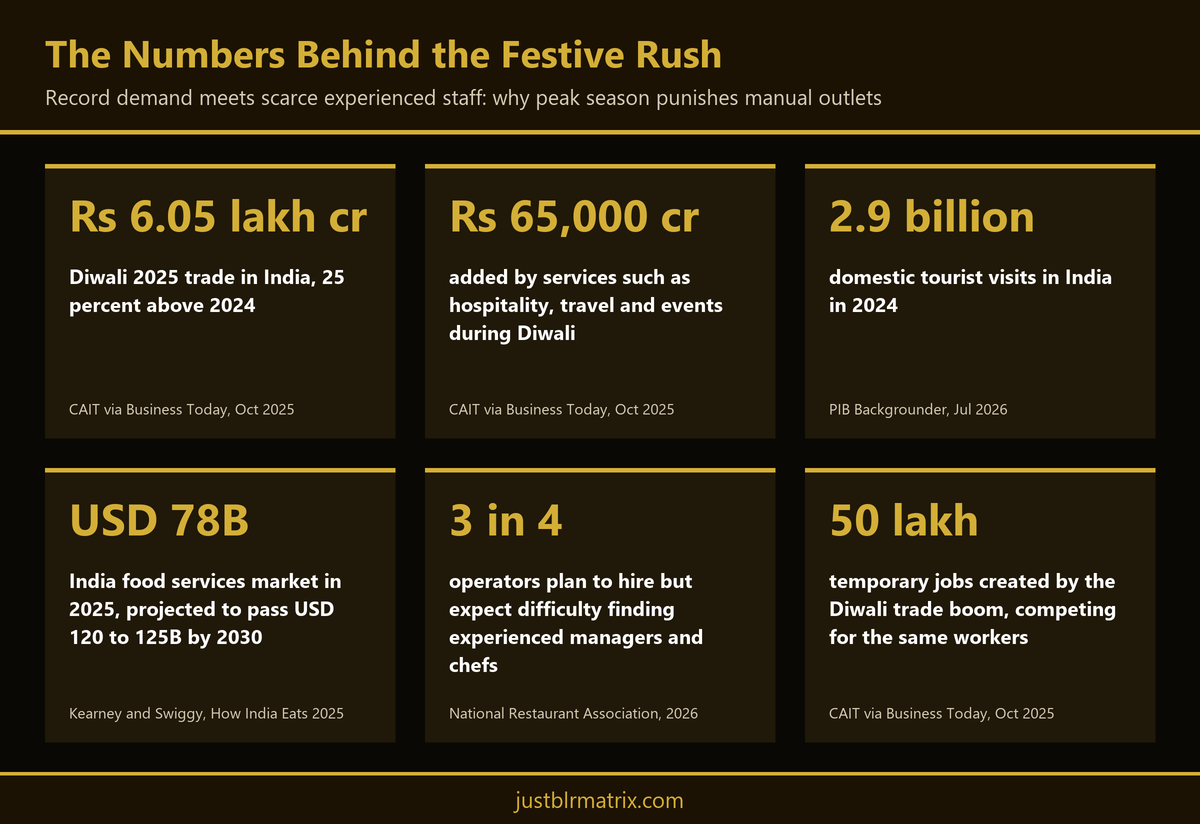
India's festive economy keeps setting records, and the Confederation of All India Traders reported Diwali 2025 trade of Rs 6.05 lakh crore, a 25 percent jump on the previous year. For restaurants, that surge arrives as packed tables, stacked delivery tickets and kitchens running at full stretch. Festive season restaurant automation is how owners turn that demand into profit instead of chaos. If you want to see it working on a real line, talk to the Just BLR Matrix team in Bengaluru. This guide explains why manual outlets lose the most during peak weeks, and how to prepare before the 2027 season begins.
Key Takeaways
- Festive season restaurant automation protects margin when orders peak and experienced staff are hardest to find, so the biggest losses fall on outlets still relying only on manual work.
- Owners comparing a kitchen automation system for peak season near me should target the real bottlenecks first: prep, frying, bulk cooking and dishwashing.
- Installing an AI POS billing system before year end 2027 gives teams time to train before the rush, rather than learning a new screen on the busiest night.
Why the Festive Rush Exposes Every Weak Link
Peak season does not create new problems in a restaurant. It magnifies the ones that already exist. A slow prep station, a single billing counter or a short dishwashing team can be managed on a quiet Tuesday. During festive weeks, the same gaps turn into long waits, wasted food and lost covers.
The demand is real and it is growing. The CAIT report found that services added Rs 65,000 crore to Diwali trade, spread across travel, hospitality, logistics and event management. Travel feeds dining too. The Government of India's backgrounder on India as a tourism hub records 2.9 billion domestic tourist visits in 2024, with tourism and hospitality supporting 84.6 million jobs in 2023 to 2024. Many of those visitors eat out, order in and gather in groups during the holidays. For a restaurant, every extra cover during these weeks carries a higher value, because fixed costs are already paid. That is exactly why lost covers hurt so much. When a kitchen cannot keep pace, guests leave, delivery partners cancel and ratings drop at the moment visibility matters most. Festive season restaurant automation tackles these gaps before they become expensive.
Consider a typical Saturday in late October. Group bookings arrive together, delivery apps send a steady stream of orders and the kitchen is still cutting onions by hand. Each delay pushes the next one back. By nine in the evening, the outlet is turning away walk ins while the dining room still has empty tables waiting to be cleared. Outlets with festive season restaurant automation in 2027 will handle that same evening differently, because machines carry the repetitive load and people focus on cooking and hospitality.
The Staffing Squeeze Behind Peak Season Losses
Most festive losses trace back to people, not demand. Owners try to hire extra hands for a few weeks, but experienced cooks are scarce and new temporary staff need training. Automation reduces how much the outlet depends on finding perfect people at the worst possible time.
The hiring problem is global. The National Restaurant Association's 2026 State of the Restaurant Industry findings show nearly three quarters of operators plan to hire, yet expect difficulty finding experienced managers and chefs. More than 9 in 10 operators cite food, labour, energy and other costs as significant challenges, and 42 percent said their restaurant was not profitable last year. Those are US figures, but Indian owners will recognise the pattern, especially in a competitive city like Bengaluru. Festive demand also competes for the same workers. CAIT estimates the Diwali trade boom created 50 lakh temporary jobs in logistics, packaging, transport and retail. When your temporary cook can earn similar money elsewhere, retention during peak weeks becomes uncertain. Festive season restaurant automation does not replace your team. It lets a smaller, trained crew handle more orders with consistent quality, so one absence does not collapse the whole line.
Where Automation Protects Margin During the Rush
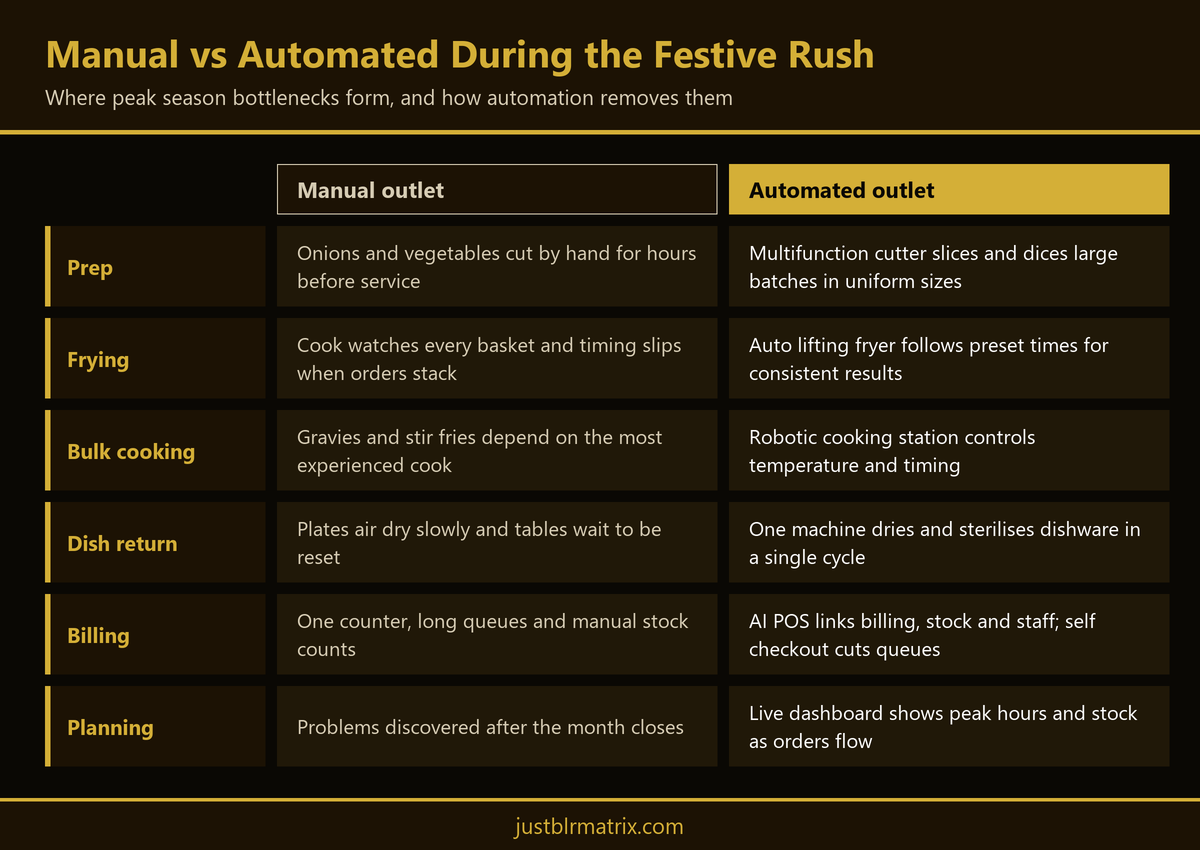
The smartest automation investments follow the queue. Owners should find where orders actually wait during peak hours and fix those stations first. In most Indian kitchens, the pressure points are vegetable prep, frying, bulk cooking and the dish return area, which all slow down sharply when volumes double.
Start with prep, because every dish depends on it. A high capacity multifunction vegetable cutter slices, dices, shreds and chops in large volumes with uniform sizes, which frees cooks from hours of manual chopping before service. Frying is next. The Robo Fryer lowers and lifts the basket automatically on preset timings, so snacks come out the same whether the shift is calm or slammed. For curries, gravies and stir fries, the Robotic 4 Way Cooking Machine handles several cooking methods with precise temperature and timing control. Finally, clean plates are often the hidden bottleneck. An electric dryer and dish sterilizer dries and sterilises dishware in one cycle, so tables reset faster. Owners searching for a kitchen automation system for peak season near me should ask vendors which of these stations they can automate first, and how quickly.
Fixing the Billing Queue Before Year End
A fast kitchen means little if guests wait twenty minutes to pay. The billing counter is where festive frustration becomes visible to every customer. Connecting billing with inventory, staff and kitchen data gives owners control of the whole outlet, not just the till.
The Just BLR Matrix AI Command POS brings reservations, table allocation, staff attendance, inventory tracking, machine reporting and customer history into one dashboard. Owners can ask the JB AI Bot about peak hours or stock levels through a simple chat interface, and inventory updates automatically as orders are processed. For outlets with heavy walk in traffic, a self settlement cashier station lets guests review their bill and pay independently, which reduces queues during peak hours. Timing matters here. Installing an AI POS billing system before year end 2027 means staff can learn the new workflow in quieter weeks. Teams that switch systems in the middle of December often slow down exactly when speed matters most. Plan the changeover early, run it through a normal weekend, then let the festive season test a team that already trusts the system. Billing is also where festive season restaurant automation pays back fastest, because every table that settles quickly can be reset for the next group.
Planning Your 2027 Peak Season Rollout
Automation works best as a phased plan, not a last minute purchase. Owners who map their bottlenecks after this season can budget, install and train well before the next one. The market outlook gives good reason to plan ahead, because organised restaurants are growing faster.
The Kearney and Swiggy How India Eats 2025 report values India's food services industry at USD 78 billion in 2025 and projects it to surpass USD 120 to 125 billion by 2030. The organised segment is expected to grow at 12 to 14 percent a year, compared with 5 to 7 percent for unorganised players. The outlook for 2027 is clear: organised outlets that run consistent, data led operations will capture more of that growth. Costs are moving in a helpful direction too. The Ministry of Tourism has told Parliament that the GST changes effective 22 September 2025 reduced rates on many items used in hospitality, such as refrigerators and air conditioners, lowering operating costs and capital expenditure for the sector. A simple rollout plan helps. First, record wait times at each station during this year's festive weeks. Second, automate the single worst bottleneck before the next season. Third, connect your billing with kitchen and inventory data. Fourth, add further machines in stages, guided by real numbers. Our complete guide to restaurant kitchen automation covers each category in more depth, and the full catalogue of kitchen, bar and service machines helps you shortlist options. Treat festive season restaurant automation as a yearly cycle of review and upgrade, and the 2027 rush becomes a planned event rather than a scramble.
Conclusion
The festive rush rewards restaurants that are ready and punishes those that are not. Record demand, scarce experienced staff and rising costs mean manual outlets lose the most when tables fill up. Festive season restaurant automation lets a trained team serve more guests with consistent food, faster turns and shorter billing queues. Owners who start planning now can automate their worst bottleneck and train staff well before the 2027 peak. Ready to map your first step? Book a demo with Just BLR Matrix in Bengaluru and see the machines working before the rush begins.
Frequently Asked Questions
What is festive season restaurant automation?

Why do restaurants without automation lose the most during peak season?
Which kitchen station should I automate first before the festive rush?
How early should I install an AI POS billing system before year end?
Can automation help when experienced cooks are hard to hire?
Does automation replace restaurant staff during the festive season?
How can I speed up food delivery to tables during peak hours?
What helps with bulk rice and steamed dishes during festive orders?
Where can I see kitchen automation machines in Bengaluru?