Bar Drink Shaker: Electric and Robotic Options
 General
A bar drink shaker seems too simple to automate. That impression is why recipe drift persists in venues that have already invested heavily elsewhere. Shaking controls dilution, temperature and texture, and doing it by hand produces a different result depending on who is working and how tired they are. This guide covers what an electric cocktail shaker changes operationally, where it fits against full cocktail robotics, and how to choose between the two.
Key Takeaways
- Shaking is a measured process, not a flourish. Duration and intensity determine dilution and texture, and both vary widely between staff and across a shift.
- An automatic drink shaker is the lowest cost entry point into cocktail consistency, well below the cost of a full robotic station.
- Shakers suit venues with a defined signature list. Wide, frequently changing menus are usually better served by a full station.
What Shaking Actually Controls
Shaking performs three jobs at once, and most bar training treats only the first as important. It mixes the ingredients, it chills the liquid, and it dilutes the drink by melting a controlled amount of ice into it.
That third function is the one that decides whether a cocktail is correct. Dilution is not a side effect to be minimised. It is part of the recipe, and a drink shaken too briefly is harsh while one shaken too long is watery. Both failures are common, and neither is visible until the guest tastes it.
Texture is the fourth outcome, particularly for drinks containing citrus, egg or cream, where aeration determines the mouthfeel. Achieving that consistently by hand requires genuine skill sustained across an entire shift, which is a demanding expectation during a busy Saturday service. Wikipedia's entry on the cocktail shaker covers the mechanics of the different formats in more detail.
Consistency here compounds across the menu. Dilution affects not only the drink being shaken but the guest's expectation of every subsequent order, since a table that receives two noticeably different versions of the same cocktail will question the whole list. Controlling one variable properly therefore protects the perceived quality of drinks the machine never touches.
Why Recipe Drift Costs More Than It Seems
Recipe drift is the gap between how a cocktail tastes when your most experienced bartender makes it on a quiet evening and how it tastes when your newest hire makes it during a rush. In most venues that gap is substantial.
The commercial cost appears in two places. The first is repeat business, since a guest who enjoyed a signature drink and returns for a different version of it has been given a reason not to come back a third time. The second is margin, because inconsistent technique means inconsistent pour and inconsistent ice use, which affects cost per serve in ways stock reconciliation rarely isolates.
Automation addresses this by making agitation a fixed input. An automatic cocktail and mocktail shaker applies the same duration and intensity to every serve, which converts a skill dependent variable into a controlled one. Staff still build the drink; the machine simply removes the step where consistency was most likely to fail.
Drift is hardest to manage precisely when it matters most. On a quiet evening an experienced bartender has time to work carefully, and standards hold. During a Saturday rush, when the largest share of weekly revenue is taken, technique degrades under pressure across the whole team at once. Automation holds the standard steady exactly where manual process is weakest.
Electric Shaker or Full Cocktail Robotics
These two categories solve overlapping problems at very different price points, and choosing between them depends on the shape of your menu rather than the size of your venue.
An electric cocktail shaker automates one step and leaves the rest to staff. It is inexpensive, occupies little space, needs no plumbing, and can be introduced without changing service choreography. It suits venues with a defined signature list where the bottleneck is consistency rather than throughput.
A full robotic station automates the whole build, from measuring through to mixing. It costs considerably more and changes how the bar operates, but it handles wide menus and high volume in a way a shaker cannot. A robotic cocktail and mocktail station fits that case, while a single arm robobar sits between the two. For a full comparison across formats and price points, see our guide to the top robotic cocktail machines for bars in India.
There is a sensible middle path that many venues overlook. Automating the shake while leaving the build manual preserves the visible craft that guests associate with a good bar, which matters in venues where the bartender is part of the experience. Full robotics changes that theatre, so consider the room's character alongside the operational maths.
Mocktails and the Non Alcoholic Shift
Any assessment of shaking equipment that considers only alcoholic drinks will size the requirement too low, because it ignores where volume is actually growing.
The non alcoholic segment has expanded quickly across Indian metros, and mocktails are prepared by the same staff, during the same rush, using the same equipment. Many of them are shaken, since citrus and fruit purees are common in the category and both need proper agitation to work. A venue that automates only the spirited side of the menu leaves half the bottleneck untouched.
There is a service argument as well. Mixed groups where only some guests are drinking are now a large share of Indian bar revenue, and those tables order across both categories simultaneously. Equipment that handles both keeps the whole table served at the same pace, which matters more to the experience than any individual drink does.
The trend also affects capacity planning. Non alcoholic orders arrive alongside alcoholic ones rather than instead of them, so a venue seeing genuine growth in the category is seeing growth in total shaken serves, not a substitution. Sizing equipment on alcoholic volume alone will therefore understate requirement, and the shortfall appears during exactly the busiest periods.
Choosing, Placing and Introducing the Equipment
Three practical points determine whether an automatic drink shaker delivers what it promises.
First, match capacity to your busiest hour rather than your menu length. Count shaken serves during peak, not the number of shaken recipes on the list, since a handful of popular drinks usually accounts for most of the volume. Second, place the unit within the bartender's existing working arc. Equipment requiring a step away from the station gets bypassed during exactly the rush it was bought for.
Third, introduce it deliberately. Staff who see automation as a comment on their skill will work around it. Framed correctly, as removing the step most likely to fail under pressure so they can concentrate on guests and on the drinks that genuinely need judgement, adoption is straightforward. The wider sequencing logic for bar equipment is covered in our complete guide to bar automation systems, and the India Food Services Report from the National Restaurant Association of India gives useful sector context on staffing pressures.
Cleaning routine is the last practical consideration and the one most likely to be neglected. Equipment handling citrus, cream and fruit purees requires a defined cleaning cycle between uses, and a unit that is awkward to strip down will quietly stop being cleaned properly during busy weeks. Ask to see the cleaning process demonstrated before purchase, not described.
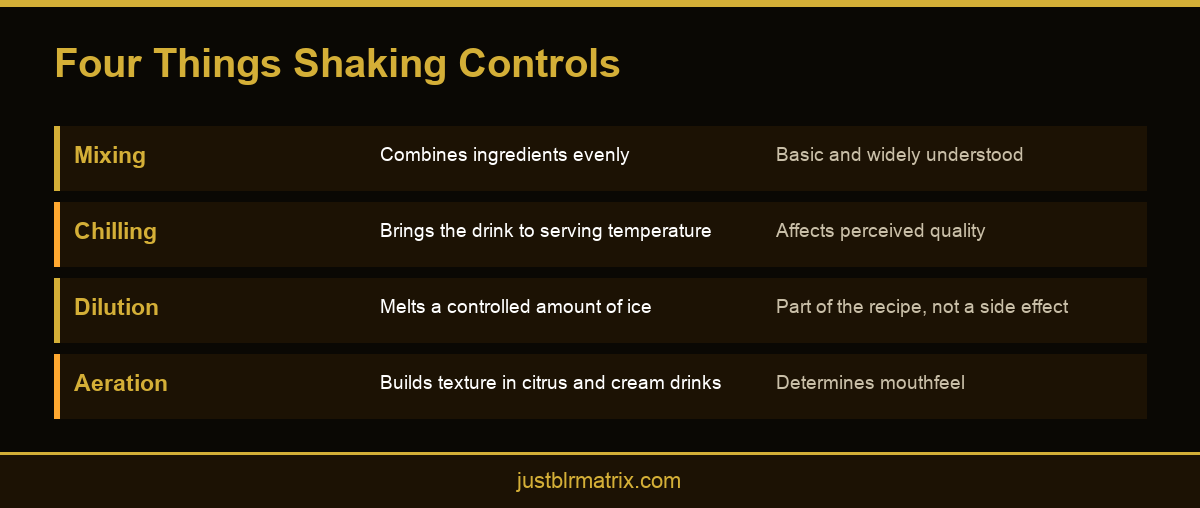 Infographic showing the four outcomes controlled by shaking a cocktail correctly
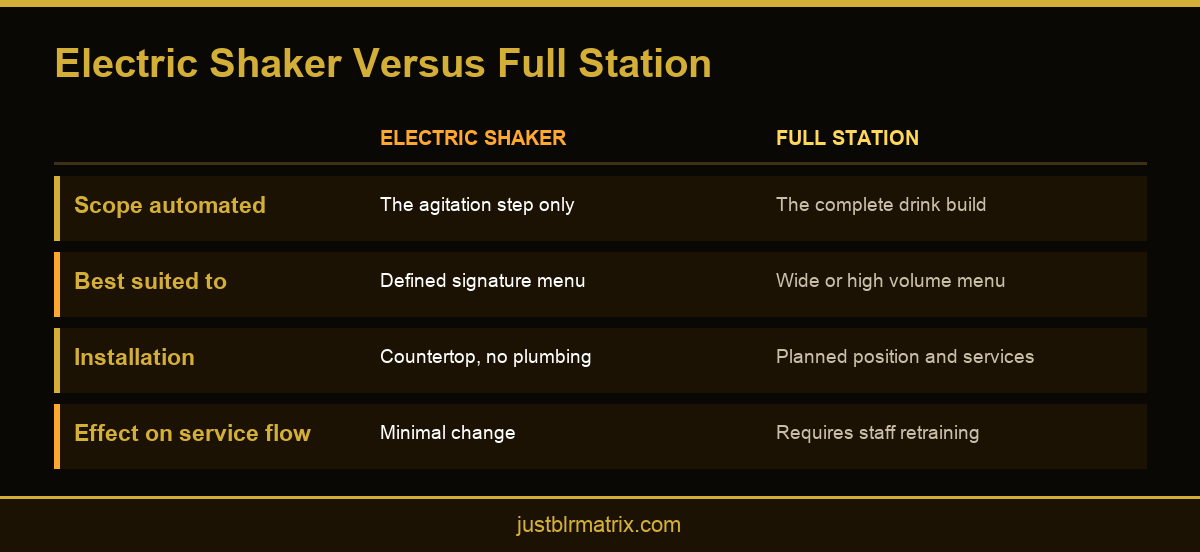 Infographic comparing an electric cocktail shaker against a full robotic cocktail station
Conclusion
A bar drink shaker is the cheapest way to buy cocktail consistency, and it fixes the step where consistency most often fails. Choose an electric shaker when your menu is defined and the problem is drift; choose a full station when the menu is wide and the problem is throughput. Cover mocktails in the same decision, since that is where volume is growing fastest. Just BLR Matrix supplies both formats, proven across 34 live outlets. Request a demo to compare them against your own menu.
Frequently Asked Questions
What does a bar drink shaker actually control?

Is an electric cocktail shaker worth it for a small bar?
How does a shaker compare with full cocktail robotics?
Will automating the shake reduce drink quality?
Do automatic drink shakers handle mocktails?
How should I size shaking capacity?
Where should the unit be placed behind the bar?
How do I get staff to adopt it?
What should I automate after the shaker?