Automatic Pizza Dough Press Machines for Commercial Kitchens
 General
A pizza base press with logo imprinting solves a problem every pizza operator recognises. Bases come out a different diameter, a different thickness and a different weight depending on who is on shift. That variance shows up as inconsistent bake times, uneven cheese coverage and customer complaints that are hard to trace. This guide covers how a press works, what output it delivers, how logo imprinting changes the economics, and what to check before you commit to one for an Indian kitchen running long service hours.
Key Takeaways
- A dough press fixes base diameter, thickness and weight so bake time becomes a constant rather than a variable.
- Output is measured in bases per hour, and most Indian outlets need far less capacity than they are quoted.
- Logo imprinting turns every base into a branded surface, which is unique among kitchen technology purchases.
- Dough temperature and hydration matter more to press performance than any setting on the machine itself.
Why base consistency is the real problem
Hand stretching is a craft skill and craft skills vary. A trained pizzaiolo produces an even base within a narrow tolerance. A commis on his third week does not. In a single outlet with one specialist that variance is manageable. Across six outlets with rotating staff it becomes the single largest source of quality complaints on the menu.
The variance compounds downstream. A base that is two millimetres thicker needs longer in the oven, which means the topping dries out under the element. A base that is two centimetres wider takes more sauce and more cheese, which quietly moves your food cost without appearing on any report. Dough behaviour is unforgiving in exactly that way, and the losses accumulate silently across a month.
A press removes the variable entirely. You set diameter and thickness once, and every base after that matches. Bake time becomes a fixed number the oven team can rely on, which in turn makes conveyor oven settings predictable and lets you standardise a recipe card across every outlet in the group.
The training benefit is larger than the speed benefit and rarely gets quoted. A new joiner can produce a correct base on day one instead of in week six. For a chain opening outlets faster than it can train specialists, that is the whole business case in a single sentence, and it is the reason multi outlet groups adopt presses long before single site operators do.
None of this replaces the pizzaiolo in a premium wood fired room, where hand stretching is part of the product. It replaces the pizzaiolo in a QSR, a cloud kitchen or a banquet line where pizza is volume output rather than theatre, and consistency is what the guest is actually paying for.
Output, thickness and how presses are specified
Presses are rated in bases per hour, and the bands are wide. A compact manual lever unit does roughly 150 to 250. A semi automatic hydraulic press does 300 to 500. A fully automatic press with an infeed and outfeed conveyor does 700 and above. Almost every operator we speak to has been quoted a band higher than the kitchen will ever use.
Work out the number honestly. Count your peak hour pizza covers, not your daily total, and add a buffer for party bookings. A busy Bengaluru QSR doing 400 pizzas across a full day rarely exceeds 90 in any single hour, which a mid band press covers with headroom to spare.
Thickness range is the specification that separates units. Look for a machine that presses from about three millimetres for a thin crust up to eight or nine for a pan base, with a repeatable adjustment rather than a loose screw. If your menu carries both styles, confirm the changeover takes seconds and not minutes.
Platen heating is the other differentiator. A heated platen relaxes gluten as it presses, which produces a base that does not spring back on the tray. An unheated platen is cheaper and works, but you will need a longer rest before topping. Decide which fits your service flow before you compare prices.
Diameter range should cover every size on your menu plus one you might add. Many operators buy for their current two sizes and then discover the machine cannot do a party size. The DoughPrint Pro automatic pizza base press handles a wide diameter band and adds a feature no other category has.
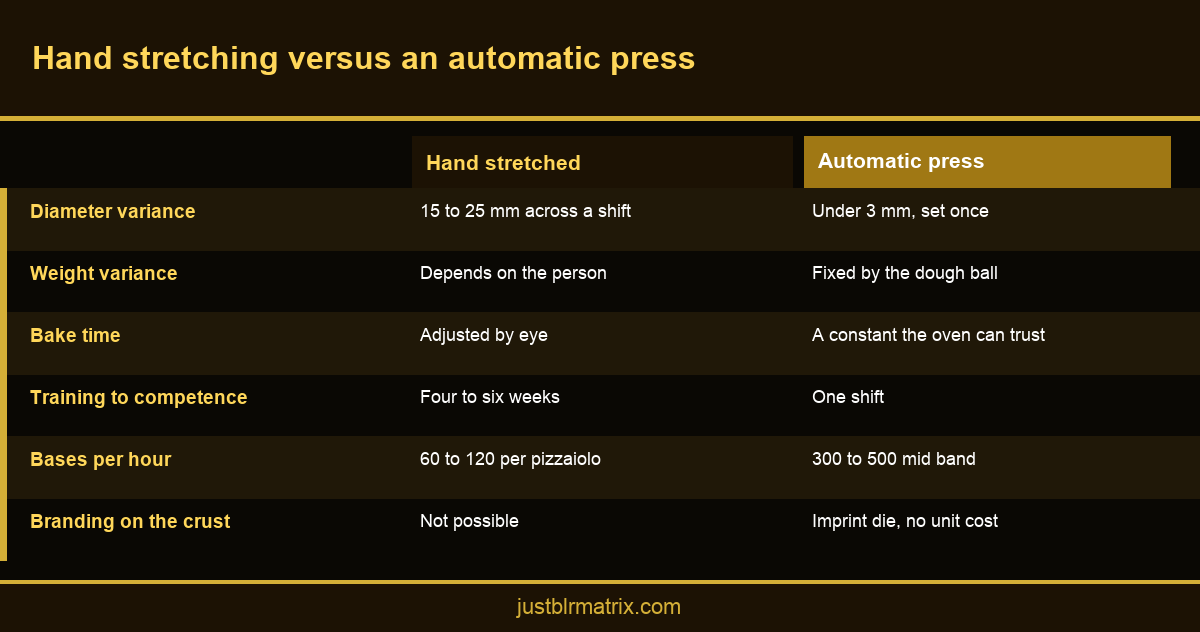 Comparison infographic of hand stretched pizza bases against an automatic pizza dough press
Logo imprinting and what it changes
A press with a logo imprint die stamps your brand mark into the base as it forms. The mark bakes in and stays visible under the sauce line and around the crust edge. It costs nothing per unit once the die is made, and it converts a commodity product into a branded one at zero marginal cost.
For delivery led brands that matters more than it first appears. A pizza that arrives in a plain box with an unbranded base is indistinguishable from a cloud kitchen competitor. A branded crust survives the journey, reaches the table intact and is the last thing the guest sees before eating.
It is also a quiet anti substitution control for franchise groups. If a franchisee is buying bases from a cheaper local supplier rather than the approved commissary, an unbranded crust makes that obvious during an audit visit without anyone needing to check an invoice or run a stock reconciliation. The control costs nothing to operate once the die is cut.
The practical considerations are die depth and dough hydration. Too shallow and the mark disappears during proving. Too deep and the base tears at the imprint under a heavy topping. A supplier who has actually run this in production will give you a die depth recommendation against your specific flour.
Pair the press with a masala, marinade and pizza dough mixer and the whole base process becomes controlled from flour to tray. Mixing consistency feeds pressing consistency, and pressing consistency feeds bake consistency. Fixing one stage while leaving the other manual gives you half the benefit.
Buying checks, dough handling and maintenance
Ask to see the machine run your dough, not the supplier's demonstration dough. Indian flour blends, hydration levels and ambient humidity behave differently from a European test kitchen. A press that performs beautifully on a 62 percent hydration dough may stick badly on the 58 percent blend your kitchen actually uses.
Check the platen release surface and how it is cleaned. Dough residue bakes onto a heated platen and hardens. A surface that needs a scraper at the end of every shift will not be cleaned properly, and an uncleaned platen transfers marks onto the next day's bases. Ask to watch the closing clean before you buy.
Confirm the safety interlocks. A hydraulic press with a hand access point needs a two hand control or a guard that stops the platen. This is basic and most reputable machines have it, but it is worth checking on any unit quoted at an unusually low price.
Ask about spares and consumables. Platen coatings wear, seals perish and dies need replacing when a brand refreshes. Get the lead time on each in writing. Downtime on a base press stops pizza service completely, which is why the service and support question deserves as much attention as the headline price.
Finally, decide where the press sits inside your wider plan. It belongs in the same conversation as forming and prep automation covered in the kitchen technology guide, because the layout, the power provision and the staffing model all change together rather than one machine at a time.
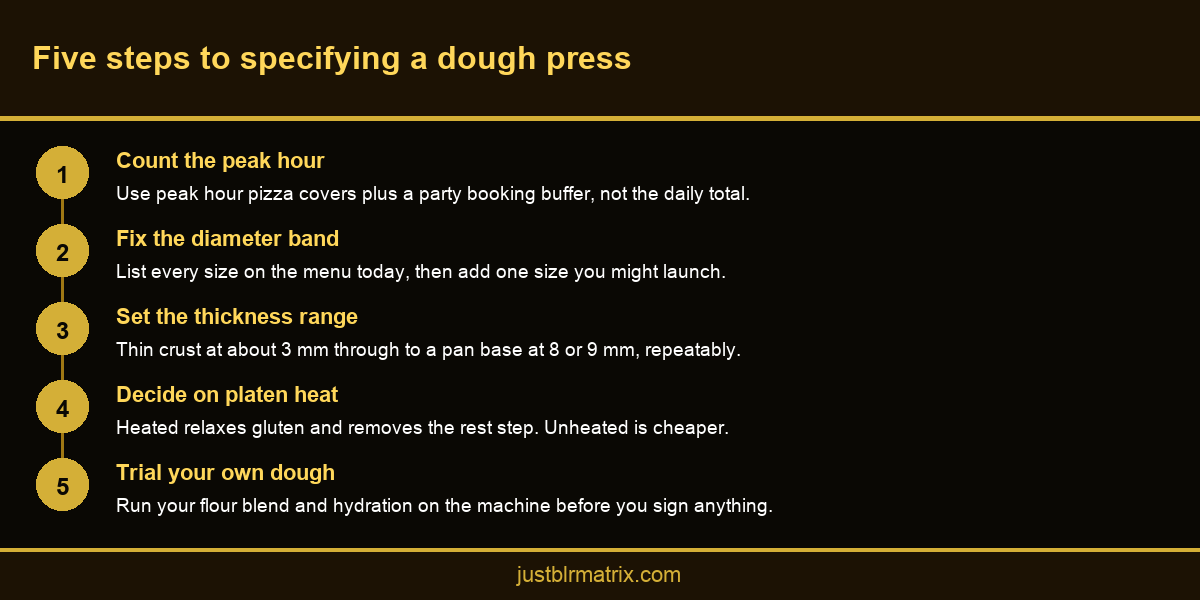 Five step infographic showing how to specify an automatic pizza dough press for a commercial kitchen
Conclusion
An automatic pizza dough press is a consistency purchase before it is a speed purchase. It fixes diameter, thickness and weight so bake times stop moving, it lets a new joiner produce a correct base immediately, and with an imprint die it turns every crust into a branded surface. Size it against your peak hour rather than your daily total, and test it on your own dough. Get a quote and we will run your blend on the machine first.
Frequently Asked Questions
What does an automatic pizza dough press actually do?

How many bases per hour do I need?
Is a heated platen worth the extra cost?
What thickness range should I specify?
How does logo imprinting on a pizza base work?
Will a dough press work with Indian flour blends?
What maintenance does a commercial dough press need?
Does a press replace the pizzaiolo?
What should a dough press be paired with?