Agni.ai Ingredient Feeder: The Complete Cooking Bot Guide
 Kitchen Automation & Smart Cooking
The Agni.ai ingredient feeder is the module that turns a Cooking Bot from a smart wok into a kitchen that seasons itself. It holds sauces, pastes, oil, water and fresh ingredients in separate channels, then releases each one at the exact moment a recipe calls for it. This guide explains how the Agni.ai ingredient feeder works, which Cooking Bot models it pairs with, the kitchens that gain most from it, what it costs to own, and how to plan a rollout that holds up during a Friday night rush.
Key Takeaways
- The Agni.ai ingredient feeder adds 8 liquid, 2 thick liquid and 4 fresh ingredient channels, plus dedicated oil and water lines, to a Cooking Bot.
- Its value is timing and dose, not speed alone: the same quantity lands at the same second in every batch, at every outlet.
- It suits cloud kitchens, QSR chains and central kitchens running a fixed menu at volume, and it is the core of robotics in food preparation for a growing chain.
- Plan the purchase around recipe programming and daily refill routines, because those decide whether the feeder delivers on paper or in service.
What is the Agni.ai ingredient feeder?
The Agni.ai ingredient feeder is an automated dispensing module built for the Cooking Bot range from Just BLR Matrix. It sits beside the cooking robot and feeds it. Where a cook would reach for a ladle of stock, a spoon of paste or a handful of chopped onion, the feeder releases a measured quantity through a dedicated channel at a programmed point in the recipe.
That distinction matters because a cooking robot on its own controls heat, stirring and time. It does not, by itself, decide when the garlic goes in or how much soy reaches the pan. Without a feeder, a person still stands beside the machine adding ingredients by hand, which reintroduces the variation the robot was bought to remove.
With the feeder attached, the whole recipe becomes a programme. Heat, stir, add oil, add aromatics, add sauce, reduce, finish. Each step runs from the touchscreen, and each ingredient arrives in the quantity the head chef set when the recipe was built. That is what Just BLR Matrix means when it describes the system as replicating a chef's dish with one click.
It is worth being clear about what the feeder is not. It is not a standalone cooker and it does not chop. Prep still happens upstream, on a line that might include a multifunction vegetable cutter and a marination station. The feeder takes prepared ingredients and delivers them into the pan on schedule.
How it fits into a robotic cooking line
Think of a robotic line in three stages. Prep produces cut vegetables, portioned protein and base sauces. The Agni.ai ingredient feeder stores those in its channels during service. The Cooking Bot heats, stirs and cooks as each channel releases into it. Plating and dispatch follow. The feeder is the bridge between a prepared station and an automated pan, and it is the stage most kitchens skip when they first price a cooking robot.
Why a feeder matters more than a faster wok
Operators often compare cooking robots on batch size and cook time. Those figures matter, but the larger source of complaint in a chain is inconsistency: one outlet's gravy is saltier, another's stir fry is wetter. That variation comes from ingredient timing and dose, not from heat. A feeder addresses the variable that guests actually notice, which is why it often changes outcomes more than a bigger burner.
Inside the 16 channels: what each one handles
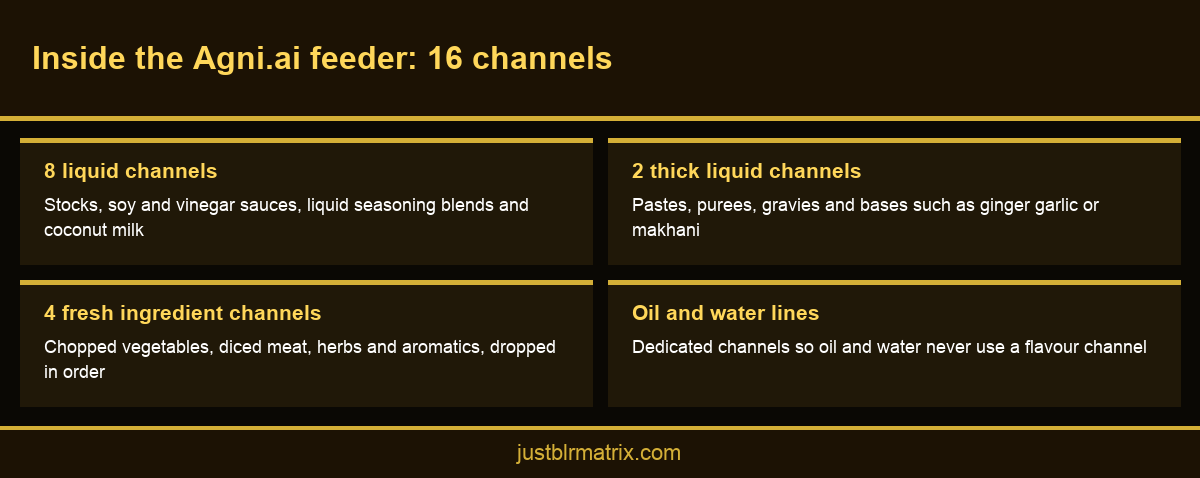
The Agni.ai ingredient feeder carries four kinds of channel, and understanding them is the starting point for deciding whether your menu fits. Just BLR Matrix lists 8 automated liquid feeders, 2 semi liquid or thick liquid feeders, 4 fresh ingredient feeders, and separate dedicated channels for oil and water.
The eight liquid channels handle thin, pourable ingredients: stocks, soy and vinegar based sauces, liquid seasoning blends, coconut milk and similar. Eight is a generous number. A typical Indo Chinese or North Indian menu runs on four to six liquid bases, which leaves room for a seasonal special without rearranging the station.
The two thick liquid channels are built for pastes, purees, gravies and bases that will not flow through a thin line. Ginger garlic paste, tomato puree, a makhani base or a Schezwan paste belong here. Because there are only two, these channels are the constraint most menus hit first, and recipe planning should start with them.
The four fresh ingredient channels drop solids: chopped vegetables, diced meat, herbs and aromatics. These are the channels that make the system feel like a cook rather than a sauce dispenser, because they let the robot add onions before tomatoes and greens at the very end, in the right order.
The dedicated oil and water channels complete the cycle. Oil goes in at the start, water adjusts consistency mid cook, and neither occupies a channel you would rather use for flavour. Together the channels let a full dish run without a hand entering the pan, which is also why Just BLR Matrix highlights sealed, hands free dispensing as a hygiene advantage.
Mapping a menu onto the channels
List every ingredient across the dishes you plan to automate, then group them by texture. Count thin liquids, thick pastes and solids separately. If the thick paste count exceeds two for a single dish, either combine pastes into one premixed base or keep that dish on a manual line. Most kitchens find that standardising two master pastes unlocks most of the menu.
Where the touchscreen fits
Recipes are selected and run from the touchscreen interface, which Just BLR Matrix describes as easy to operate even for unskilled staff. The skill moves from the line cook to the person who writes the recipe programme. That shift is the real operating change, and it is covered in our planned guide to recipe programming for the feeder.
Which Cooking Bot models does it pair with?
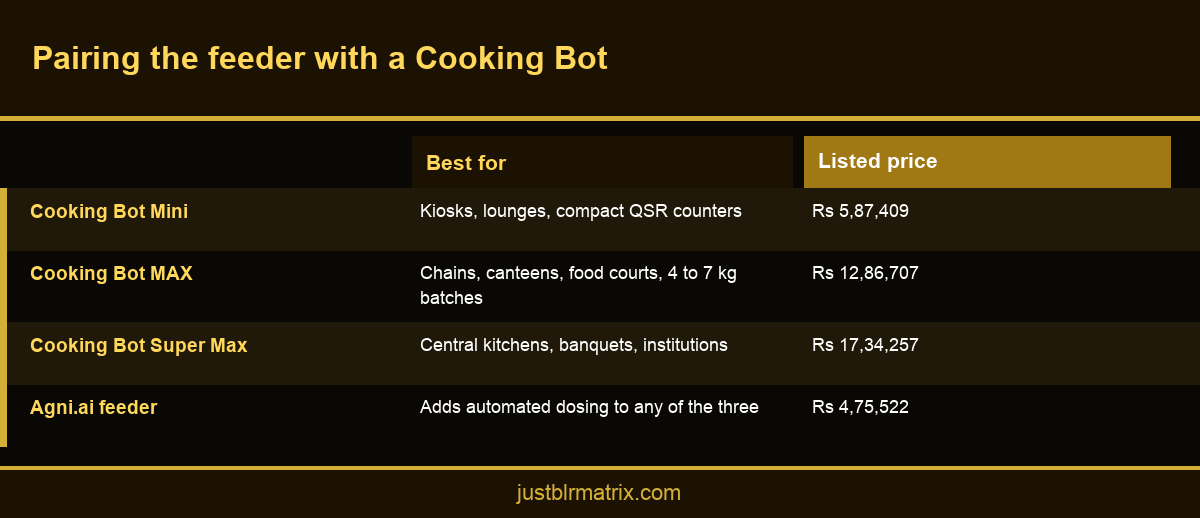
The feeder is designed specifically for the Cooking Bot range, and the right pairing depends on batch size. The compact Cooking Bot Mini suits small format kitchens, kiosks and lounges where counter space is tight and batches are single portions or small family servings.
The Cooking Bot MAX is the middle of the range. Just BLR Matrix lists it at 4 to 7 kg batches, with three smart seasoning modules for powder, liquid and sauce. It is the model most chains, canteens and food courts start with, because that batch size covers a lunch rush without staging.
The Super Max for large batch cooking is aimed at central kitchens, hotel banquets and institutional catering, where one programme might feed a few hundred covers. At that scale the feeder's role shifts from consistency to throughput, because nobody can season a batch that size by hand at the same rate.
A useful rule is to size the robot to your peak hour and then confirm the feeder's channel count suits your menu. The robot decides capacity. The feeder decides how much of the menu that capacity can actually cook without a person standing beside it.
If you are still choosing between cooking platforms, the wider comparison of robotic cooking hardware in our roundup of eight robotic kitchen machines is a useful first read before you decide on a model.
Which kitchens benefit most from an ingredient feeder?
Not every kitchen should buy one, and saying so saves money. The feeder pays off where the menu is fixed, the volume is high and consistency across sites is a business requirement rather than a preference.
A quick test helps. Count how many times a day your top ten dishes are cooked, and how many outlets cook them. If the answer runs into hundreds of portions across more than one site, the feeder's programming effort is spread across a large base and the case strengthens quickly. If it runs into dozens at a single site, a well trained cook and a good recipe card may still be the better investment for now. The sections below describe the kitchen types where the numbers usually work.
Cloud kitchens and delivery brands
Delivery brands live and die on ratings, and ratings punish inconsistency. A cloud kitchen running several virtual brands from one site benefits twice: each brand's recipes stay identical across shifts, and one operator can run several robots. This use case is detailed in our planned guide to the feeder for cloud kitchens.
QSR chains and multi outlet groups
A chain wants the butter chicken in Indiranagar to taste like the one in Whitefield. The feeder makes that a programming task instead of a training task. When the recipe changes, the change is pushed once, rather than retrained at every outlet.
Central kitchens and institutional catering
Hospital, campus and corporate kitchens cook the same dishes in large batches every day. Here the feeder's value is labour and timing. One supervisor can oversee several batches while the feeder handles dosing that would otherwise need a cook per pan.
Where it is not the right buy
A fine dining kitchen with a changing tasting menu, or a small restaurant with very low covers, will rarely recover the cost. The programming effort for a dish cooked six times a week is the same as for a dish cooked six hundred times. Volume is what makes that effort pay.
What the Agni.ai ingredient feeder costs to own
Just BLR Matrix lists the Agni.ai ingredient feeder at Rs 4,75,522 on its product page. That is the module only. It is bought alongside a Cooking Bot, and the robot is listed separately: the Mini at Rs 5,87,409, the MAX at Rs 12,86,707 and the Super Max at Rs 17,34,257. Confirm with the team whether a quote includes GST, installation and delivery.
Budget beyond the hardware too. Recipe programming takes chef time during setup. Staff need training on refill routines and cleaning. Channels need a daily clean down, and ingredients need to be prepared in the consistency the channels expect. None of these is large, but all of them belong in the cost case.
On the other side of the ledger sit labour, waste and consistency. Just BLR Matrix states that the system reduces labour dependency by 60 to 80 percent and cooks dishes in 3 to 5 minutes. Treat those as the manufacturer's figures and test them against your own menu. Our planned pricing guide works through a payback model step by step, and the ten ways automation lowers kitchen costs give useful context.
The strongest financial case usually comes from consistency rather than headcount. A chain that loses repeat orders to variable taste is losing revenue that never shows up as a line item. The feeder protects that revenue, which is harder to quantify but often larger than the wage saving.
Hygiene, food safety and audit trails
Automated dispensing changes the food safety picture in useful ways. Every time a hand enters a pan or a ladle moves between containers, there is a contact point. The feeder removes many of those points, because ingredients travel from a sealed channel to the pan without being handled during service. For a kitchen working toward FSSAI licensing and hygiene requirements, fewer contact points is a genuine improvement rather than a marketing line.
The channels themselves become a control point, though, and they need the same discipline as any other food contact surface. Decide how often each channel is flushed, which cleaning agents are approved, and who signs off the clean down. Write it into the opening and closing checklist so it never depends on memory.
Temperature is the second consideration. Prepared pastes, stocks and cut vegetables sit in the feeder during service. Plan how long each ingredient may stay loaded and how leftovers are handled at the end of a shift. Kitchens that already run a hazard analysis and critical control point plan can add the feeder as a step in that plan rather than inventing a separate process.
The third gain is traceability. A programmed recipe records what went into a dish and in what quantity. When a guest reports an allergen concern, or an auditor asks how a recipe is controlled, a kitchen with locked programmes has a clearer answer than one relying on each cook's habits.
Allergen control with dedicated channels
Assign allergen bearing ingredients such as peanut, sesame or soy sauces to fixed channels and label them. Never rotate an allergen into a channel that normally carries a neutral base without a full flush. The fixed map makes allergen questions answerable from the programme rather than from memory, which matters in a busy delivery kitchen.
What auditors will ask
Expect questions about cleaning frequency, ingredient holding times and who can edit recipes. Keep a short written record for each: a cleaning log, a holding time chart beside the feeder, and a list of staff with programme edit rights. Those three documents answer most audit questions in minutes.
Robotics in food preparation: where the feeder fits in India
India's food service market is large and still growing, and the India Brand Equity Foundation overview of the food industry tracks the scale of that opportunity. The operational pressure behind automation is more practical, though. Skilled cooks move between employers often, wage costs rise every year, and chains expanding into new cities struggle to reproduce a recipe exactly with a new team.
Automation in commercial kitchens follows the path that industrial robots took in manufacturing: first the repetitive, measurable tasks, then the coordinated sequences. Stirring and heating were the first to go. Dosing ingredients at the right moment is the next step, and that is precisely the task the feeder takes over.
The approach also respects how Indian kitchens already work. Most Indian dishes rely on prepared bases, such as onion tomato masala, ginger garlic paste or a cashew gravy, made in bulk earlier in the day. That prep habit, close to the classic mise en place, maps naturally onto feeder channels. The kitchen keeps its bulk prep and simply changes how the finished components reach the pan.
What changes is who holds the recipe. In a traditional kitchen the recipe lives with the senior cook. With a feeder it lives in the programme, owned by the head chef and protected from drift. For a growing chain that is the most important shift of all, because it stops the dish from changing every time a cook leaves.
Planning a rollout that works in service
A feeder that performs in a demonstration can still disappoint in a real service if the rollout is rushed. Five steps make the difference.
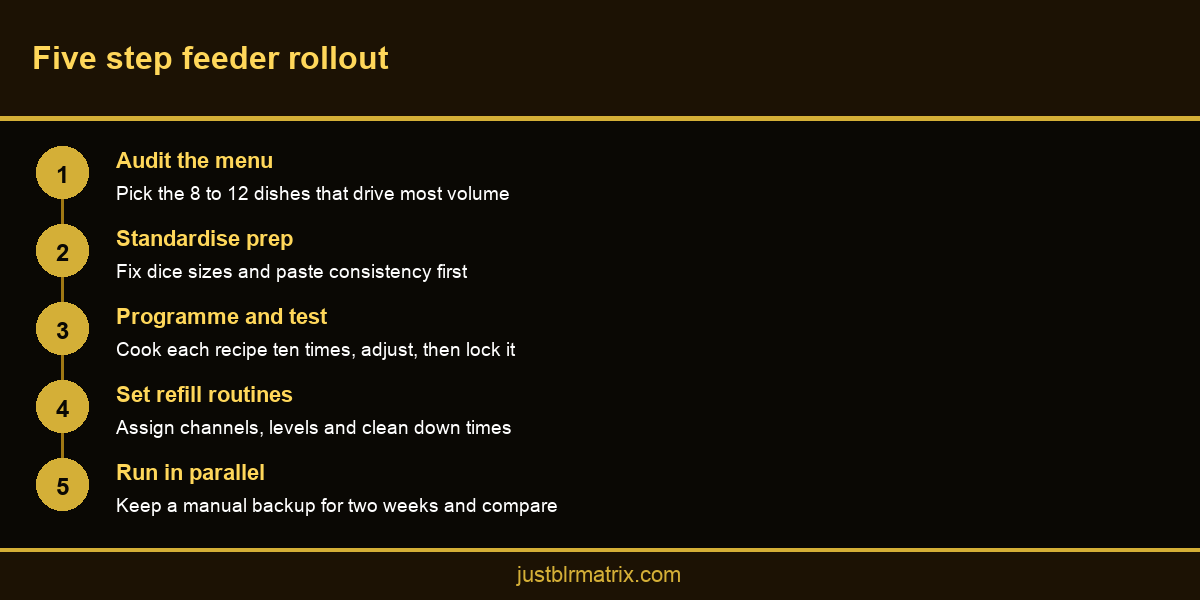
Start with the menu audit. Choose the eight to twelve dishes that account for most of your volume and map them onto the channels. Resist automating the long tail on day one.
Standardise prep next. The feeder dispenses what you put in it. If the onion dice varies or the paste is thinner on Tuesday than on Monday, results will vary too. Write prep specifications before you write recipe programmes.
Then programme and test. Build each recipe on the touchscreen, cook it ten times, adjust, and only then lock it. Involve the head chef who owns the dish, because the programme is now the recipe.
Set refill and cleaning routines before go live. Decide who refills which channel, at what level, and when the clean down happens. Most early failures are a channel running dry mid service.
Finally, run in parallel. Keep a manual backup for the first fortnight. Track complaints, waste and cook times, and compare them against the manual line. Our wider guide to automating a restaurant kitchen sets out how the feeder fits into a full kitchen plan.
Buying checklist: questions to ask before you order
Before signing, take a short list of questions to the demonstration. They turn a sales conversation into an evaluation, and they surface the operating realities early.
Ask which Cooking Bot model the quote assumes and whether the feeder ships configured for it. Ask how many of your dishes fit the 2 thick liquid channels without premixing. Ask what the daily cleaning routine involves and how long it takes. Ask who programmes the first recipes and whether that is included.
Ask about service and spares. A feeder is a mechanical system with pumps and valves, and downtime during a weekend is expensive. Clarify response times in your city and which parts are held locally. Just BLR Matrix cites 34 outlets and more than 80 smart deployments, so ask to see a running installation similar to yours.
Finally, ask how the system reports. Batch counts and dispensing logs help you prove consistency and spot waste, and they become more useful still when they sit alongside sales data in an integrated F&B command POS. If you want a guided assessment, the team can map your menu onto the channels before you commit.
Conclusion
The Agni.ai ingredient feeder is what lets a Cooking Bot cook a whole dish without a hand in the pan. Its 16 channels cover liquids, pastes, solids, oil and water, and its real value is identical timing and dose in every batch at every outlet. It suits fixed menus at volume, so start with a menu audit, standardise prep, programme carefully and run in parallel before going live. Request a demo to see your own dishes mapped onto the channels.
Frequently Asked Questions
What does the Agni.ai ingredient feeder do?
It stores prepared ingredients in separate channels and releases each one into a Cooking Bot at a programmed moment and in a set quantity. That turns a cooking robot into a system that seasons and finishes a dish without a cook adding ingredients by hand.
How many channels does the feeder have?
Just BLR Matrix lists 8 automated liquid channels, 2 semi liquid or thick liquid channels for pastes and gravies, and 4 fresh ingredient channels for vegetables, meat and herbs, plus dedicated oil and water channels for a fully automated cooking cycle.
Does it work without a Cooking Bot?
No. It is designed specifically for the Cooking Bot range of robotic cooking systems. The feeder handles dispensing, while the Cooking Bot handles heating, stirring, frying and timing, so the two are bought and commissioned together as one cooking line.
Which Cooking Bot should I pair it with?
Size the robot to your peak hour. The Mini suits compact counters and kiosks, the MAX handles 4 to 7 kg batches for chains and canteens, and the Super Max serves central kitchens. See the full range of kitchen machines for every model.
Can it handle Indian gravies and pastes?
Yes, through its two thick liquid channels, which are built for pastes, purees, gravies and bases. Because there are only two, most kitchens standardise one or two master pastes so the full menu fits without manual additions during service.
Is the Agni.ai ingredient feeder hygienic?
Dispensing is sealed and hands free, which Just BLR Matrix highlights as a hygiene advantage. Channels still need a daily clean down and prepared ingredients still need correct storage, so build both into your food safety routine before you go live.
How long does a dish take to cook?
Just BLR Matrix states that dishes cook in under 3 to 5 minutes, which suits QSR and small format kitchens. Actual times depend on the recipe, the batch size and the Cooking Bot model, so test your own dishes during the demonstration.
Who programmes the recipes?
Usually the head chef who owns each dish, working on the touchscreen during setup. Each recipe is cooked several times, adjusted and then locked. Ask whether initial programming support is included in your quote before you place an order.
Does it reduce staff costs?
Just BLR Matrix states labour dependency falls by 60 to 80 percent. The larger gain for many chains is consistency, which protects repeat orders. Model both against your own menu and wage costs rather than relying on a single headline figure.
What should I check before buying?
Confirm the Cooking Bot model in the quote, how your dishes fit the thick liquid channels, cleaning time, programming support, local service response and spares. Our blog covers the wider kitchen automation decisions that sit around the purchase.
Frequently Asked Questions
What does the Agni.ai ingredient feeder do?

How many channels does the feeder have?
Does it work without a Cooking Bot?
Which Cooking Bot should I pair it with?
Can it handle Indian gravies and pastes?
Is the Agni.ai ingredient feeder hygienic?
How long does a dish take to cook?
Who programmes the recipes?
Does it reduce staff costs?
What should I check before buying?